
A servo-controlled OCA laminating machine makes sense when a process depends on a defined pressing position, a controlled approach or a particular force response. Pneumatic pressing can be the appropriate choice when validated pressure stages and dwell conditions are enough to make the bond consistently. Neither method is an automatic route to better bonding quality.
For LCD and OLED assemblies, the more useful question is what happens as the cover, adhesive and display first make contact. The answer depends on the stack and its support—not simply on whether the press moves with a servo drive or a pneumatic cylinder.
Choose the Control Variable Before the Drive Type
Imagine two display stacks entering the same bonding operation. One combines cover glass with a well-supported, relatively rigid assembly. The other has a more compliant structure, or its tooling leaves certain regions less supported. They may use the same form of OCA film, yet the way they respond to pressing can be quite different.
That difference points to the first selection decision. If the concern is excessive load on a sensitive structure, the ability to control and verify force matters. If the approved bond requires a particular compression path or final pressing position, displacement matters. When the main risk occurs at initial contact, the approach speed and transition into pressing deserve attention.
Force, position and speed do not substitute for one another. A press can arrive at the same position with a different load when the incoming stack thickness changes. It can also apply the same total load while distributing it differently because of fixture support or platen alignment.
That is why the search for OCA vacuum laminating machines should begin with the bonding variable that must be held within a verified range. The specified adhesive and assembly limits set that range; the drive type is a means of meeting it.
When Does Force or Position Control Matter?
A force-sensitive process is not necessarily one that needs more force. Quite often, the challenge is to keep the load from rising too abruptly as the pressing surface reaches the assembly. Local support, glass thickness and the compliance of the bonded layers can all influence what the display experiences, even if the machine reports a stable setpoint.
Consider an assembly with small but meaningful thickness variation from part to part. A fixed final position could create different loads as that variation changes. In a different process, a defined final position may be exactly what the qualified bonding method requires. Neither choice is universally safer; the material limits and actual load response decide.
The moment of first contact often reveals more than the final setpoint
A process may appear stable during its holding stage and still experience an undesirable load change when the platen first touches the stack. That is where a programmable motion profile—or appropriately controlled pneumatic approach—can become important. The engineer needs to understand the transition from travel to contact, not just the number displayed at the end of the cycle.
It is equally important to know what the controller is measuring. Compressed-air pressure is not the same as measured force at the workpiece, and a servo position command is not proof of uniform compression across the optical interface. Sensor location, tooling stiffness and contact geometry all affect how a displayed value should be interpreted.
The useful question: Can the proposed machine maintain the required contact behavior when the real stack, fixture and material variation are introduced—not merely when it runs an empty-cycle demonstration?
How Do Pneumatic and Servo Configurations Differ in Practice?
Servo pressing and pneumatic pressing reach the workpiece by different mechanical routes. A servo system commands movement through an electrically controlled drive; a pneumatic cylinder responds to regulated compressed air. The distinction influences movement and force regulation, but it does not determine every other capability of the laminator.
In production, the supporting conditions can be just as revealing as the control label. Pneumatic response depends on air preparation, supply stability and valve behavior. Servo movement depends on the drive, feedback arrangement and mechanical transmission. Either can be undermined by poor support under a glass panel or by a bonding sequence that the adhesive has not been qualified to tolerate.
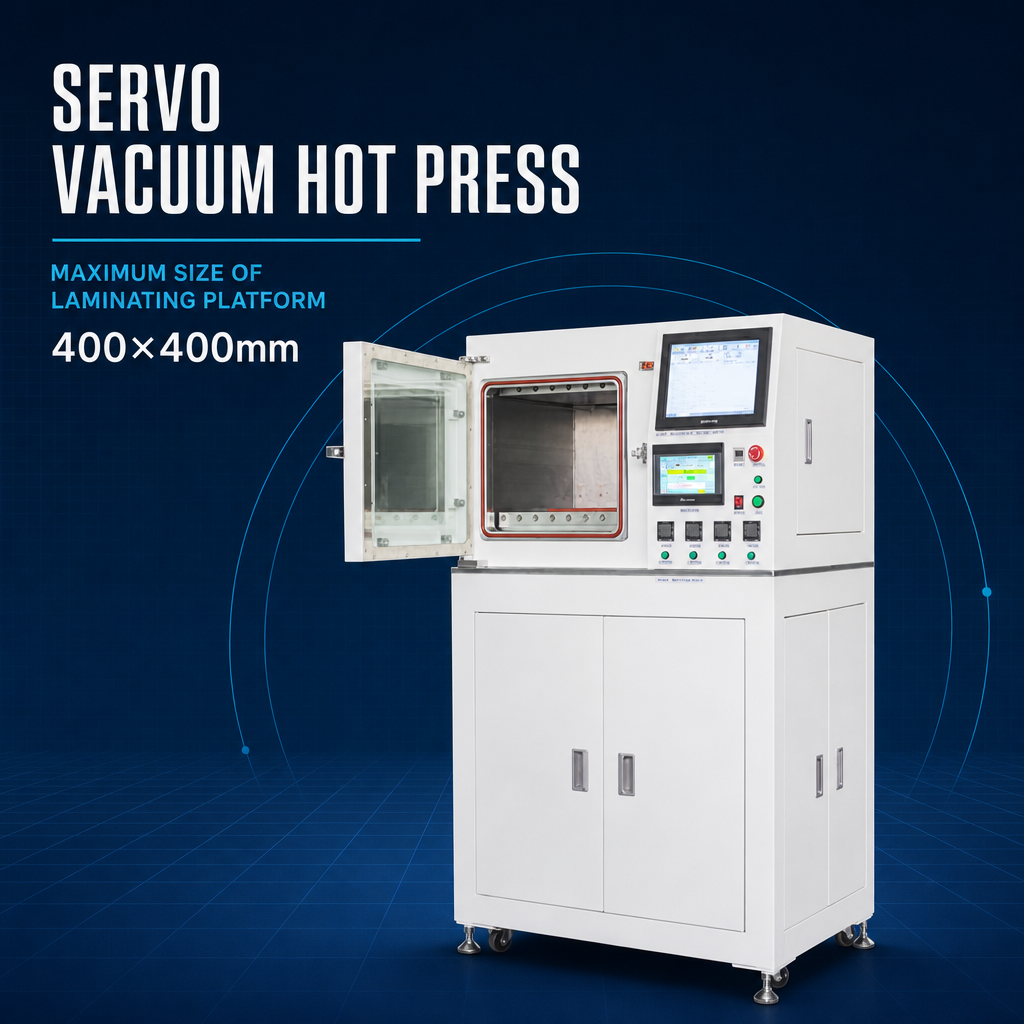
JiuTu has two relevant industrial configurations that illustrate the choice. These are examples of different control approaches, not directly matched alternatives. The 9TU-M040E has a 400 × 400 mm platform, while the 9TU-M040D provides 710 × 510 mm, so working area and fixture requirements must be considered separately from the pressing method.
When movement and pressing position matter
400×400-2T Servo Laminating Machine
This 9TU-M040E configuration lists pressure and displacement modes, with separate adjustments for pressing, detection and buffering speeds. Those functions make it a relevant machine to investigate when the trial requires a defined approach or a comparison between force-oriented and position-oriented pressing.
The available functions do not establish compatibility with a particular LCD or OLED stack. Its tooling, feedback behavior and sample results still need review.
Explore servo configuration
When a staged pressure recipe is the priority
9TU-M040D Industrial Vacuum Laminating Machine
The published 9TU-M040D configuration uses pneumatic pressure regulation and supports three automatic stages, each with a pressure setting, processing time, and vacuum on/off selection. It is relevant when the proposed bonding process can be expressed as a sequence of validated loading and holding conditions.
That is not a promise that every pneumatic machine can perform the same sequence, nor that the sequence suits every adhesive. The controlled pressure must still be related to what the actual workpiece experiences.
Review pneumatic configurationA servo model may therefore be attractive because of its configurable movement and position control, while a staged pneumatic model may already cover the pressure-time behavior required for another process. The fair decision is not “which machine is more advanced?” It is whether the extra control variable changes the bonded-sample result enough to justify that configuration.
The adhesive form must be settled separately. If material selection is still open, the related guide to adhesive form and process compatibility explains why OCA, SCA and LOCA cannot simply inherit one another’s bonding recipes.
Which Sample Trial Makes the Comparison Fair?
The most misleading comparison is to run two machines at matching numerical settings and assume the display received matching treatment. A pneumatic air-pressure value and a servo force setpoint do not describe the same physical measurement. Even two machines reporting the same load can interact differently with the stack if their tooling and contact behavior differ.
A useful trial begins with the same acceptance question: can this assembly be bonded within its supplier-defined limits, with acceptable alignment, contact and optical appearance? Use representative covers, actual adhesive grade, display modules and the intended fixture arrangement. Then let each machine use an appropriate, documented process rather than forcing both into an artificial common recipe.
The records should show what happened during contact, not only whether the panel looked acceptable when unloaded. Where instrumentation is available, compare actual force, displacement and movement with the programmed values. Keep vacuum and thermal conditions, sample preparation and inspection timing traceable. Repeat with relevant material variation to see whether an apparent advantage survives beyond one ideal sample.
“Acceptable optical bond across the defined sample range, with documented pressing behavior and inspection criteria” is useful evidence. “Servo was smoother” or “pneumatic pressure was higher” is not enough to approve a production process.
If an edge void appears repeatedly, examine support, adhesive wet-out and contact progression before blaming the drive. A particle-related defect points elsewhere again. The trial earns its value by explaining what caused the difference, not merely by producing two sets of finished panels.
For an unfamiliar or delicate display stack, it is worth discussing the proposed trial before settling on a machine. Share the layer drawing, OCA grade, fixture concept and current defect observations to request a configuration review based on the actual bonding problem.
What Should the Quotation Confirm?
By the quotation stage, “servo” and “pneumatic” should be descriptions of a defined process solution, not the main justification for buying it. A servo quotation should explain which force or displacement modes are included, how the relevant feedback is obtained and what motion parameters can be adjusted. For a pneumatic design, the same discussion should cover stage control, pressure regulation, response and the compressed-air conditions required on site.
Neither quote is complete without the surrounding process. Vacuum sequence, heating control, platen and fixture arrangement, recipe handling and sample acceptance criteria all belong in the review. Two machines with different chambers or supports cannot be judged as though their only meaningful difference were the pressing mechanism.
The strongest purchasing question is simple: What evidence will show that this configuration bonds our specified assembly within the approved process window? Ask for the proposed sample conditions and the variables that will be recorded. That moves the discussion beyond a features list toward an acceptance decision the process and procurement teams can share.
JiuTu’s bonding machine range provides the broader equipment context, while the two linked product pages show the specific control approaches discussed here. Final model selection should follow the confirmed stack and the trial—not the product name alone.
Frequently Asked Questions
Does a servo machine still need compressed air?
It may. Servo describes the pressing drive, not every utility or actuator on the machine. JiuTu’s published 400×400-2T servo configuration also lists a compressed-air requirement, so the final utility specification should be checked before installation.
Can pneumatic pressing use staged control?
Yes, if the regulation hardware and controller support it. The published 9TU-M040D configuration provides three automatic stages with individually configurable pressure and duration values, plus a vacuum on/off selection. Not all pneumatic laminators share that capability.
Does servo control guarantee better bonding quality?
No. Servo control can offer useful movement and pressing options, but bonding quality also depends on the adhesive, tooling, cleanliness, vacuum, thermal conditions and validated operating window. Representative sample results are the deciding evidence.
The right choice is the control method that can reproduce the approved bonding conditions without imposing unnecessary complexity. Servo deserves attention when the stack makes movement, compression or force behavior especially important. Pneumatic pressing remains a serious candidate when its controlled pressure stages are sufficient for the validated process.
In either case, compare the actual contact behavior and finished bond—not an assumed relationship between drive type and yield.
Application & configuration review
Bring the Display Stack Into the Equipment Discussion
A useful review starts with the assembly you need to bond, the variables you need to control and the evidence required for process approval. That gives the equipment team a practical basis for discussing servo and pneumatic configurations.
Send the relevant details: display type and layer construction, OCA supplier and grade, material limits, assembly and fixture drawings, current pressing conditions, observed defects, inspection requirements, expected output and available utilities. Representative samples or existing trial data are helpful when available.