
The choice between OCA, SCA and LOCA changes the way a display is bonded, not just the adhesive on the purchase order. OCA arrives as a film that needs clean handling and accurate placement. LOCA is dispensed as a liquid, so flow and curing become part of the production challenge. SCA is less straightforward because suppliers use the term for materials with different constructions. For an LCD or OLED assembly, the sensible choice is the route that suits the actual layer stack and can be repeated with the available equipment.
OCA vs SCA vs LOCA: What Changes in the Bonding Process?
Two optically clear adhesives may look similar in a finished display but behave very differently on the production floor. A preformed film needs accurate placement and reliable contact across the panel. A liquid has to spread without reaching connectors or other protected areas, and its cure must work with the display structure.
That is why the comparison starts with the bonding process rather than an abstract ranking of adhesive types. The important differences show up in handling, defect control, rework and the equipment needed around the laminator.
The adhesive acronym is not a machine recipe. Vacuum time, pressure, temperature, curing conditions and post-treatment should come from the actual material, panel structure and validated sample process. A setting that works for one adhesive family should not automatically be transferred to another.
A machine described as suitable for “OCA/SCA” may still lack the fixture arrangement or thermal control required by a particular material. The category on the product page is a starting point for discussion, not proof that a specific panel-and-adhesive combination has been qualified.
OCA: Why Film Handling Matters
With OCA, defects often begin before the laminator closes. Dust on a bonding surface, a misaligned sheet or damage during liner removal can remain visible after the bonding cycle. Vacuum helps the layers make contact, but it cannot erase what happened during film preparation.
The same OCA film is not automatically suitable for every display. Pressure transmitted through an LCD assembly can contribute to visible nonuniformity (mura), while curved or flexible OLED structures may place additional demands on conformability and mechanical strain. The bonding stack—not just the screen diagonal—also determines the support and working area needed for cover glass, frames, connectors and fixtures.
Confirm the correct OCA and keep the intended bonding surfaces free from particles and handling contamination.
The film must sit correctly between the intended optical interfaces before the stack is pressed together.
Vacuum, pressure, heat and timing should follow the qualified material and panel process rather than a universal preset.
Inspect alignment, particles, visible bubbles, incomplete contact and any required post-lamination treatment.
When bubbles appear, their location often matters more than a stronger vacuum setting. A void around a particle points toward cleanliness; an edge separation may call for closer examination of alignment, support and contact. Raising pressure without identifying the cause can leave the original problem untouched.
Some OCA processes add a separate pressure-and-temperature bubble-removal treatment. Others do not. Whether it helps depends on the selected adhesive, the panel structure and what the bonded samples actually show.
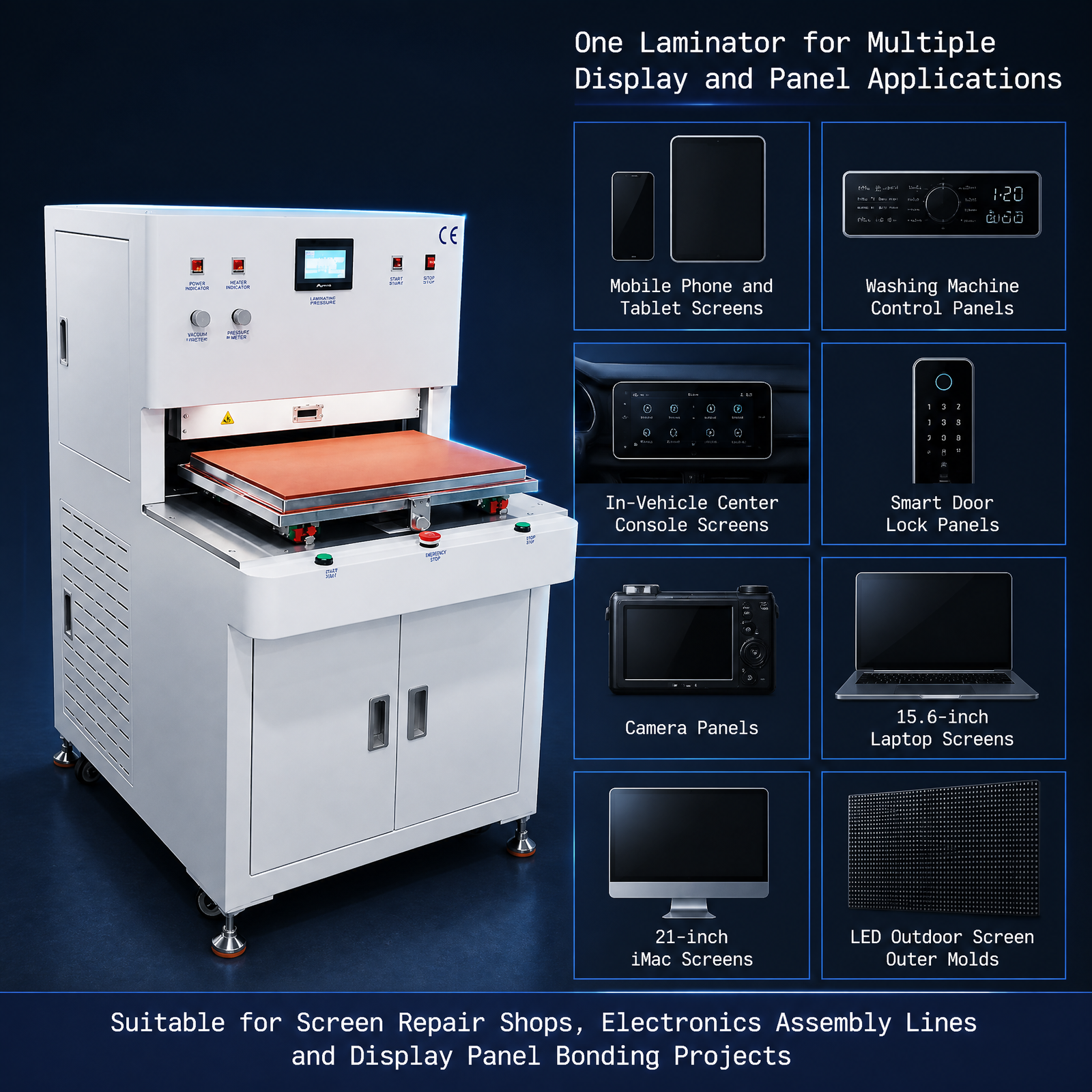
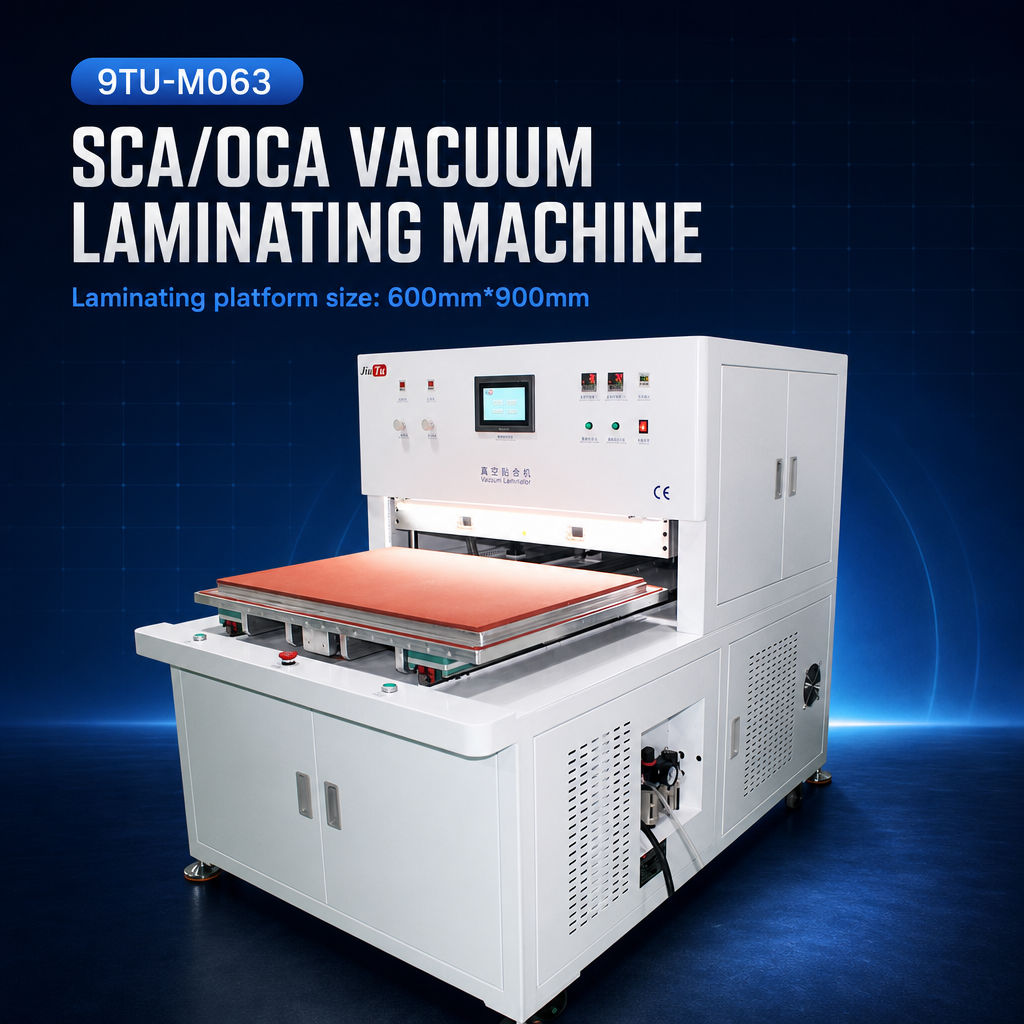
If OCA is the approved route, compare an OCA vacuum laminating machine against the complete panel-and-fixture size and the lamination conditions the material actually requires. A larger platform alone does not resolve film-placement or bonding problems.
SCA: One Name, Different Material Requirements
SCA is commonly expanded as Solid Clear Adhesive in display bonding, but equipment listings also use Super Clear Adhesive and describe solid or semi-cured adhesive gels. Those labels do not establish that the materials or their bonding processes are interchangeable. The exact adhesive data sheet must identify the supplied form and any required heating, pressure or curing conditions before a machine process is defined.
One supplier’s SCA may behave like a film-handling process; another construction may call for additional heat or conditioning. The trade-off cannot be judged from the initials alone, which is why the material code and processing instructions matter more than the label.
That distinction becomes practical when evaluating equipment. A laminator with vacuum and heating functions might cover one specified SCA process yet still be unsuitable for another because the temperature profile, material handling or post-bond requirements differ.
LOCA: When Liquid Adhesive Changes the Workflow
LOCA removes the need to position a preformed film, but it creates a different problem: the adhesive can move. As the two display layers come together, the liquid must cover the optical area evenly without leaking into a connector, an opening or a part of the assembly that must stay clean.
This makes dispensing volume, gap control and fixture design closely connected. A well-controlled dispense pattern offers little benefit if the panel support changes the way the liquid spreads during bonding.
The dispense method should match the material behavior, panel geometry and intended coverage.
Monitor edge behavior, bond gap and whether adhesive can enter regions that must remain clean.
The curing method and conditions should come from the selected LOCA documentation and validated panel process.
The cure can be just as decisive as the dispense. Some LOCA formulations are light-cured, so an opaque printed border or another shadowed feature may make complete curing more difficult. The curing route has to be evaluated against the actual assembly, not borrowed from a different adhesive.
Rework is another case where simple rankings are misleading. Whether a bonded panel can be separated and cleaned without damage depends on the chemistry and the sensitivity of the optical layers. Even on a flat LCD or OLED, the better choice is the complete process the workshop can control—not the adhesive that sounds easiest in isolation.
Which Route Fits Your Display and Production Line?
The right route becomes clearer when the panel creates a real constraint. Consider a cover lens with an opaque border and a connector close to the bonding area. A film process must maintain contact around those features; a liquid process must prevent overflow and provide a cure that reaches the adhesive. Either route may work, but each puts the risk in a different place.
The decisive question is where a particular process might lose control: at the panel edge, during placement, or after curing. The geometry, approved adhesive, existing tooling and defect pattern all offer clues, but a trial with representative panels shows how those factors interact in practice.
Panel shape is only part of the adhesive decision
Geometry affects adhesive behavior, but it should not become a one-line selection rule. A film or supplier-defined solid adhesive may be approved for one non-flat structure, while another assembly may require a different material route. What matters is whether the adhesive can conform to the real surfaces under a process that the equipment can reproduce consistently.
The bottleneck isn’t always the bonding cycle
Production planning should consider the complete line rather than one machine cycle. OCA may introduce film preparation, liner removal and positioning work. LOCA introduces dispensing and curing. An SCA route may introduce different thermal or conditioning stages. Automation changes the balance again.
What matters is how many acceptable assemblies leave the line, not how quickly one machine finishes its cycle. A faster lamination step offers little benefit if cleaning, alignment, curing or inspection is holding up production.
Good cycle times still need good yield
Even two lines with similar cycle times may deliver very different numbers of accepted panels. Yield depends on the display design, material condition, cleanliness, tooling and inspection criteria—not on whether the adhesive is labelled OCA, SCA or LOCA. Comparing the actual defects seen in a controlled trial is more useful than attaching a general yield claim to any one material.
Film-oriented route
When OCA deserves closer evaluation
OCA is a strong candidate where a qualified film is available and the line can manage clean handling, positioning and consistent contact. The remaining question is how the bonded assembly behaves in inspection, any required bubble-removal stage and rework trials.
Liquid-oriented route
When LOCA deserves closer evaluation
LOCA is worth exploring when an approved liquid can fill the intended gap and the process can keep it out of sensitive areas. Reliable dispensing is only half the job: fixtures, curing access, cleanup and rework must also work on real panels.
SCA belongs in that comparison once its actual construction is known. If the supplier-approved process suits the panel and available equipment, it may be a sound choice; the name alone says little about the result.
Matching Equipment to the Bonding Process
Once a route looks viable, the most useful equipment conversation begins with a real assembly. A supplier can assess a drawing that shows the cover glass, panel, connector positions and fixture boundary far more reliably than a screen-size label.
The adhesive data sheet fills in what the drawing cannot show: the pressure, temperature, handling or curing conditions the line needs to provide. Together, they make it possible to discuss equipment against an actual application rather than a generic machine specification.
The details that make equipment selection more useful
These details reduce assumptions before working area, tooling and machine configuration are discussed.
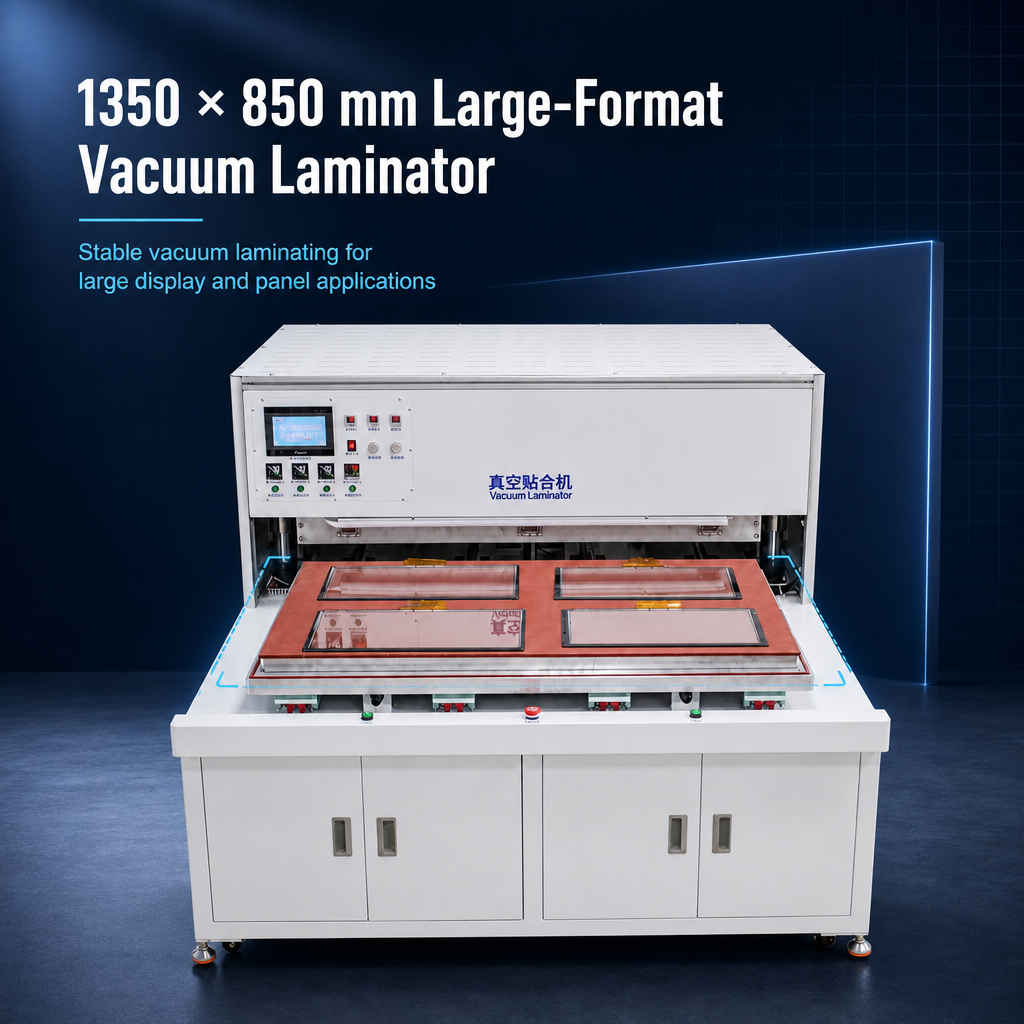
On unfamiliar materials or unusually large or curved panels, a single successful bond tells only part of the story. Representative samples reveal whether alignment, visible defects, cure and repeatability hold up under the intended process. That evidence is more useful than a machine specification taken on its own.
What happens beyond the laminator matters too
A vacuum laminator may be central to an OCA line, yet film placement can still determine whether the bond succeeds. With LOCA, dispensing and curing may be the harder constraints; a particular SCA can bring its own heating or conditioning needs. Before comparing machines, it helps to know which parts of that process the proposed equipment covers—and which it does not.
With a representative panel and material specification in hand, you can compare bonding equipment by working area and process without mistaking a physical fit for confirmed bonding compatibility.
Frequently Asked Questions
Are OCA, SCA and LOCA interchangeable?
No. Their material form and processing requirements can differ substantially. OCA is normally handled as a preformed optical adhesive film, LOCA as a dispensed liquid, while SCA should be defined from the exact supplier documentation. Switching between them may change handling, tooling, lamination, curing, inspection and rework requirements.
Which adhesive is better for flat LCD panels?
Flat geometry alone does not establish a better adhesive. Check which material is approved for the cover, touch and LCD stack, then compare handling, defect control, curing or post-treatment, rework and available equipment. OCA is a logical route to evaluate when a qualified film-bonding process exists, but flatness by itself is not enough to make the choice.
Does LOCA require different equipment from OCA?
The process normally requires different functions because LOCA must be dispensed and cured according to its material specification, while OCA is positioned as a film and then laminated. Some supporting equipment may be shared, but an OCA vacuum laminator should not automatically be treated as a complete LOCA production system.
What material information should be shared before choosing a laminator?
Share the adhesive supplier and material code, data sheet, maximum panel or assembly dimensions, LCD/OLED structure, flat or curved geometry, bonding interfaces, required heating or curing sequence, current defects and expected output. Voltage, destination and available utilities are also useful for configuration review.
Application & Configuration Review
Find Bonding Equipment That Fits Your Display Process
For an LCD or OLED project, you can explore the bonding machine range or share the panel and adhesive details below. A drawing, material code and description of the current process are usually enough to begin a more useful configuration discussion.
- Maximum panel or sample dimensions
- LCD, OLED or other display structure
- Exact OCA, SCA or other bonding material
- Material data sheet or process requirement
- Current bonding sequence
- Defect photos or process problem
- Expected daily or shift output
- Voltage, utilities and destination
A drawing or sample photo is often more useful than a long description when a fixture, border or current bonding defect is part of the problem.