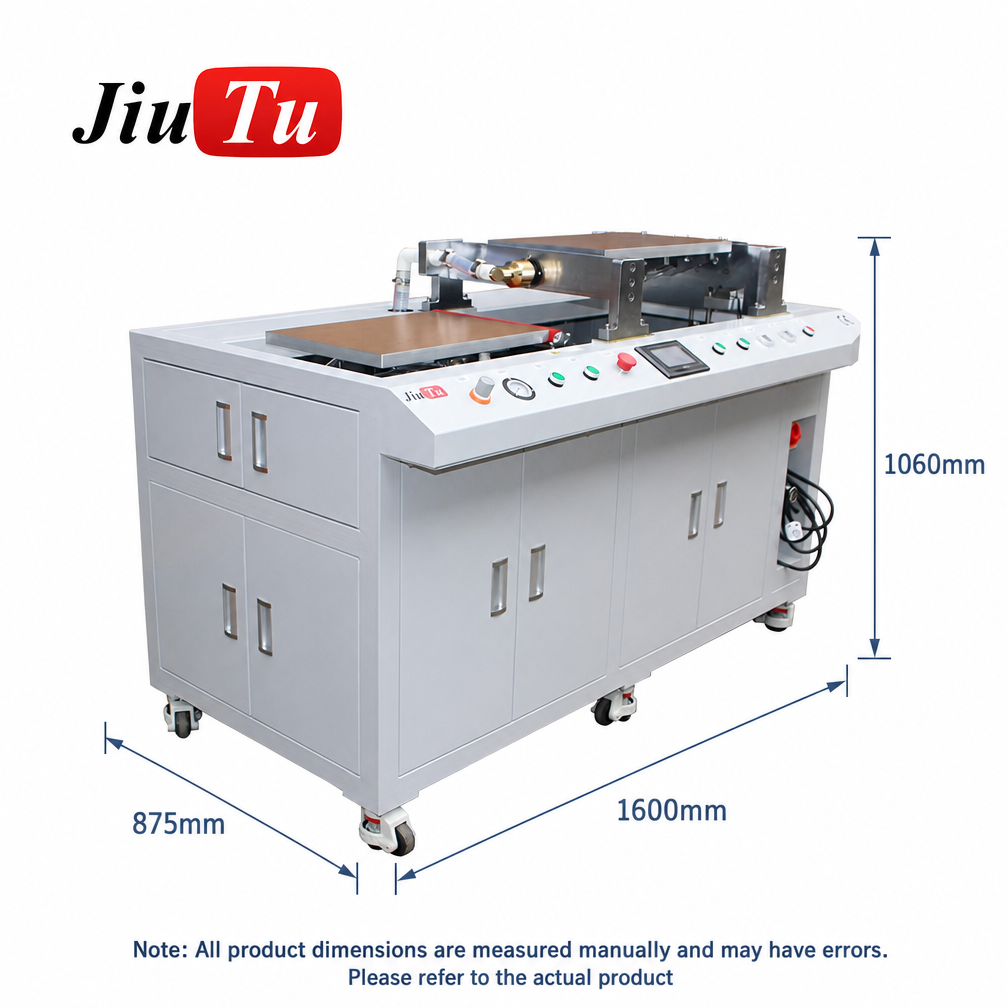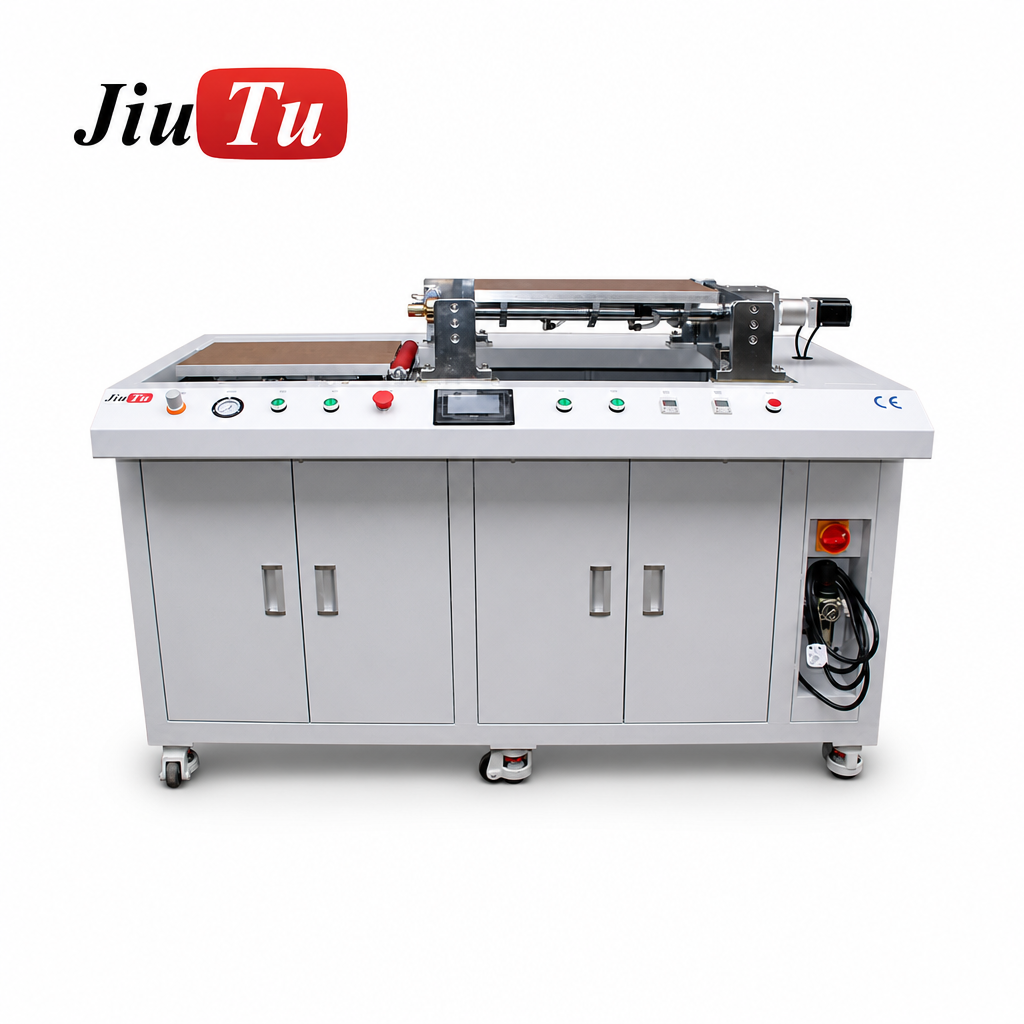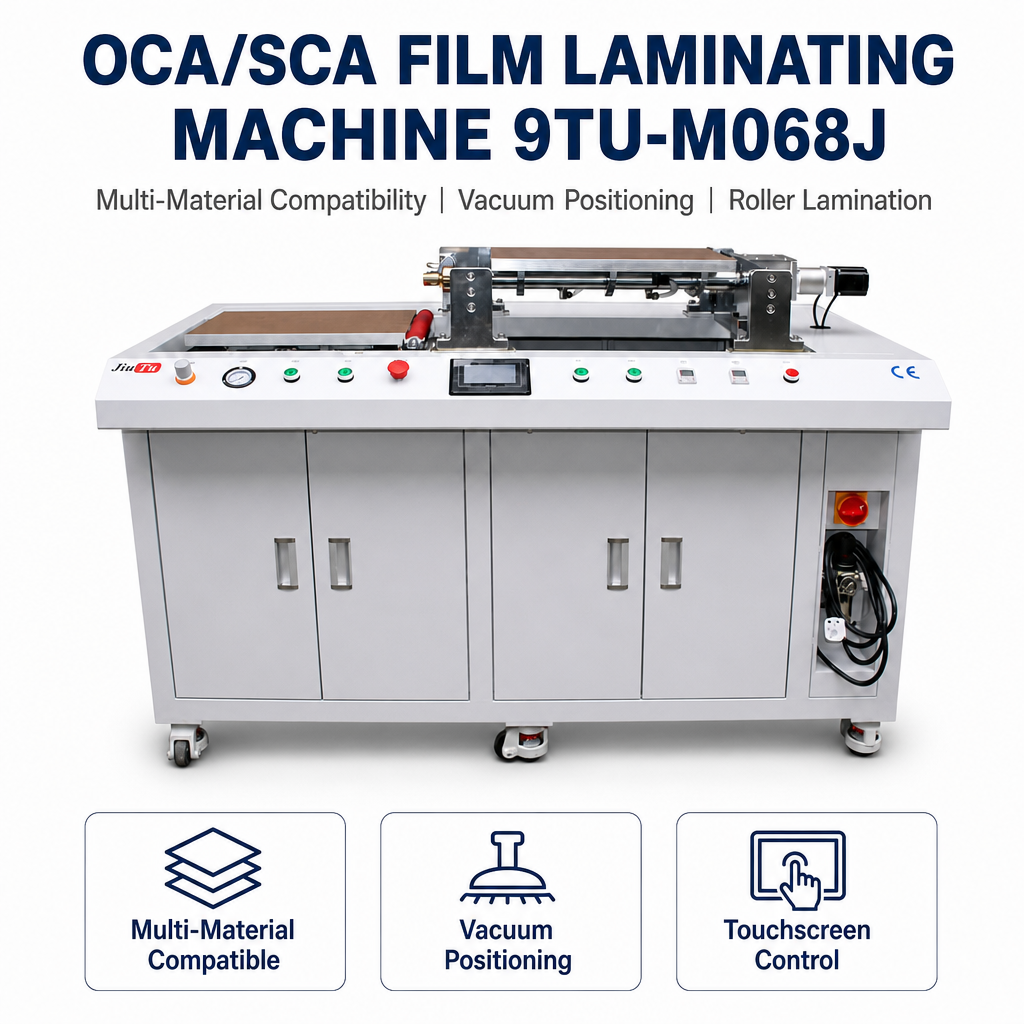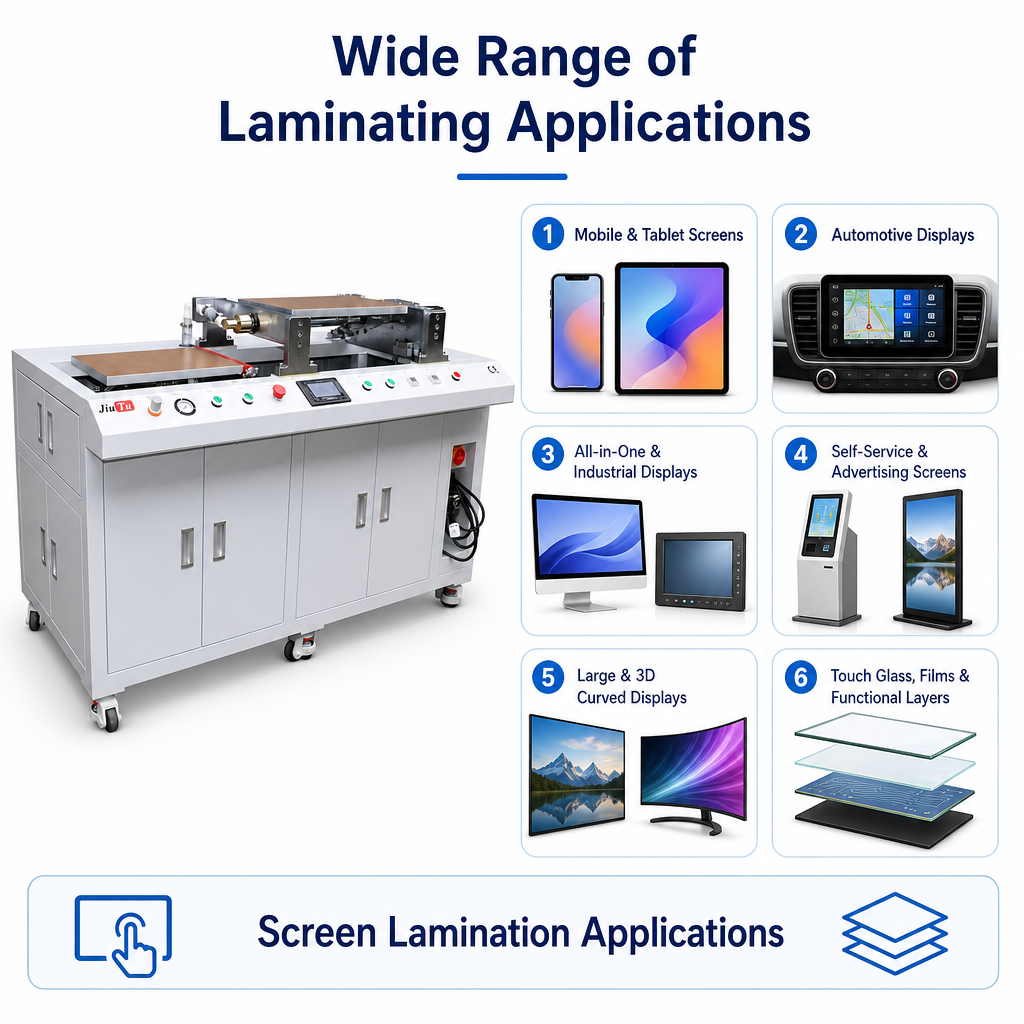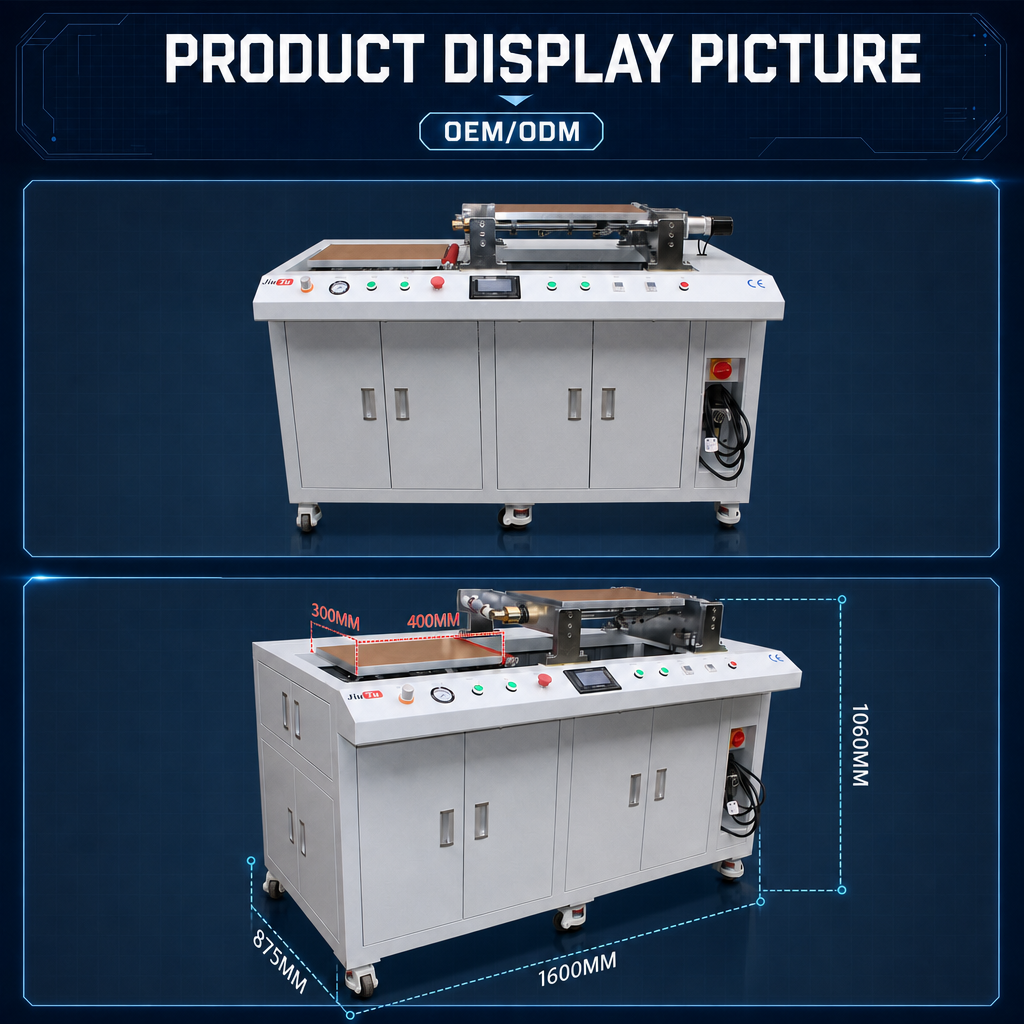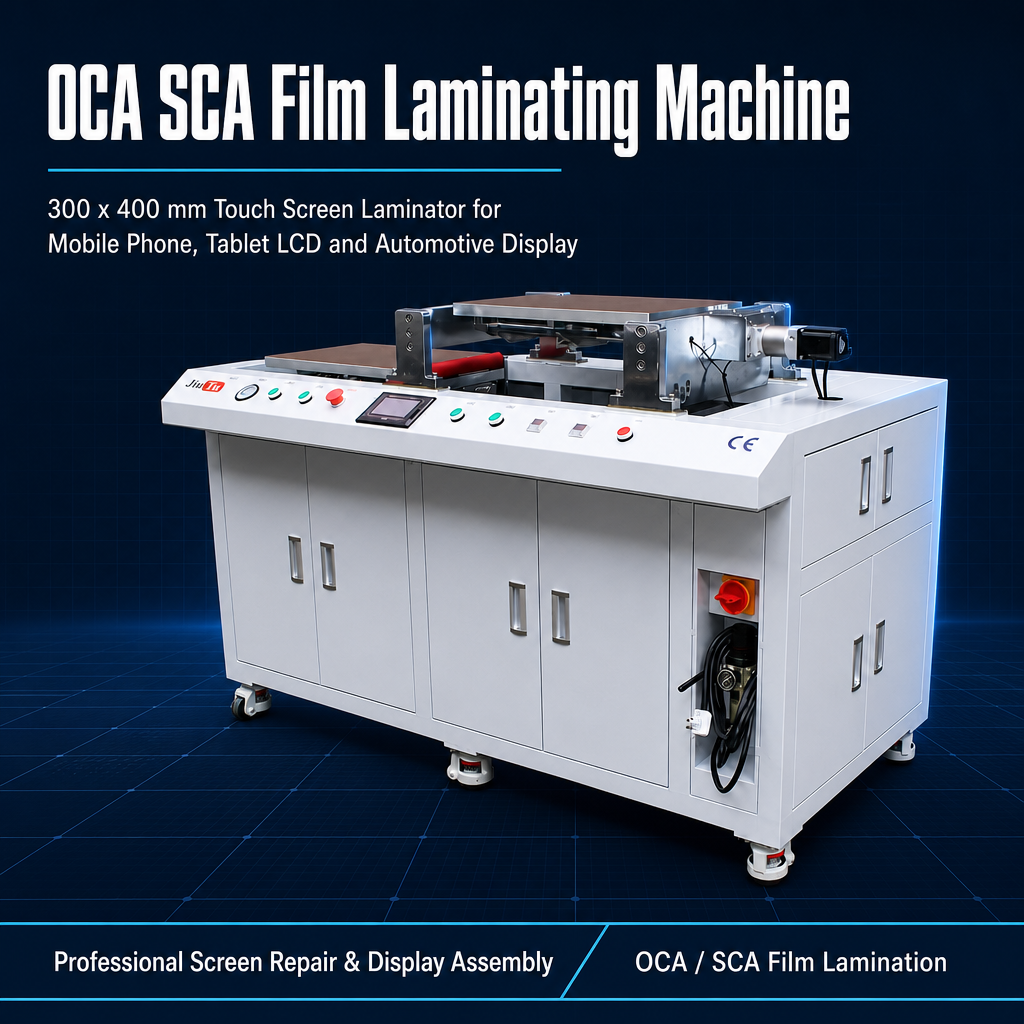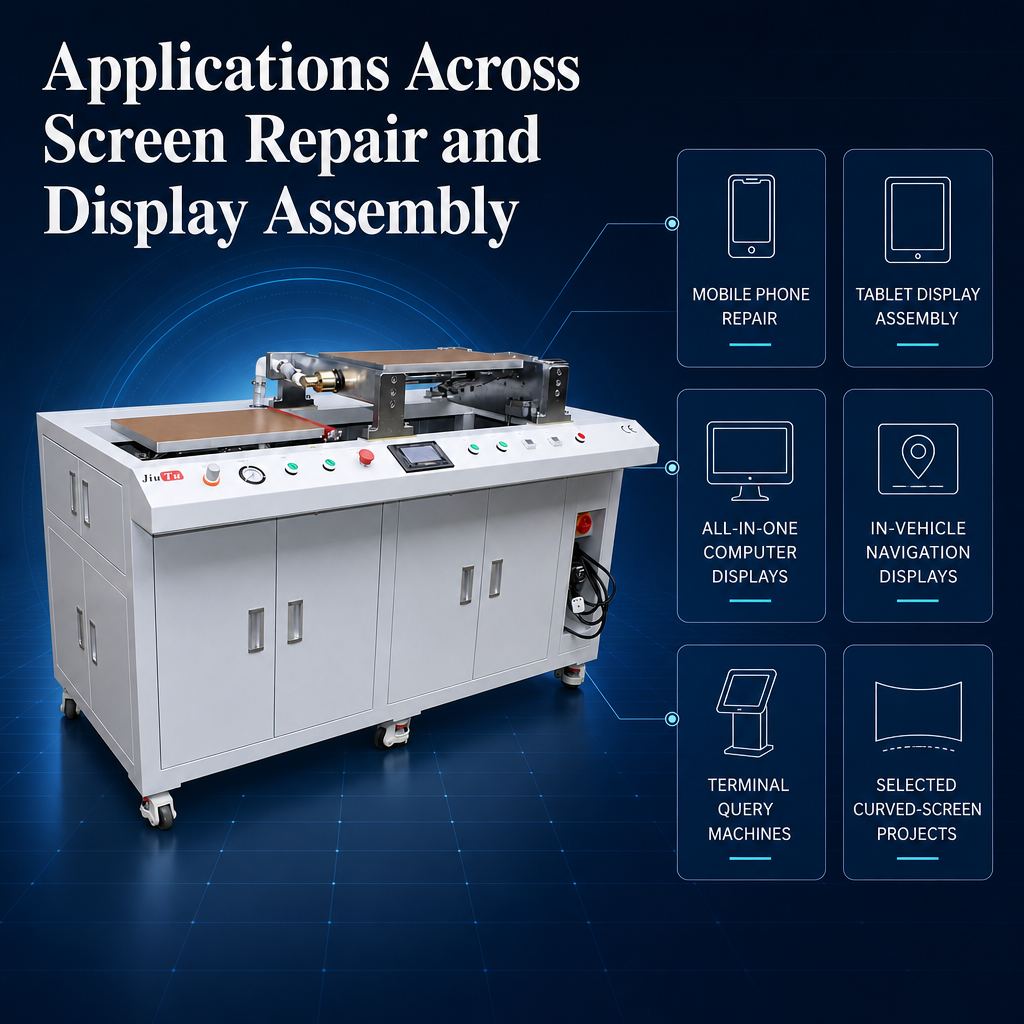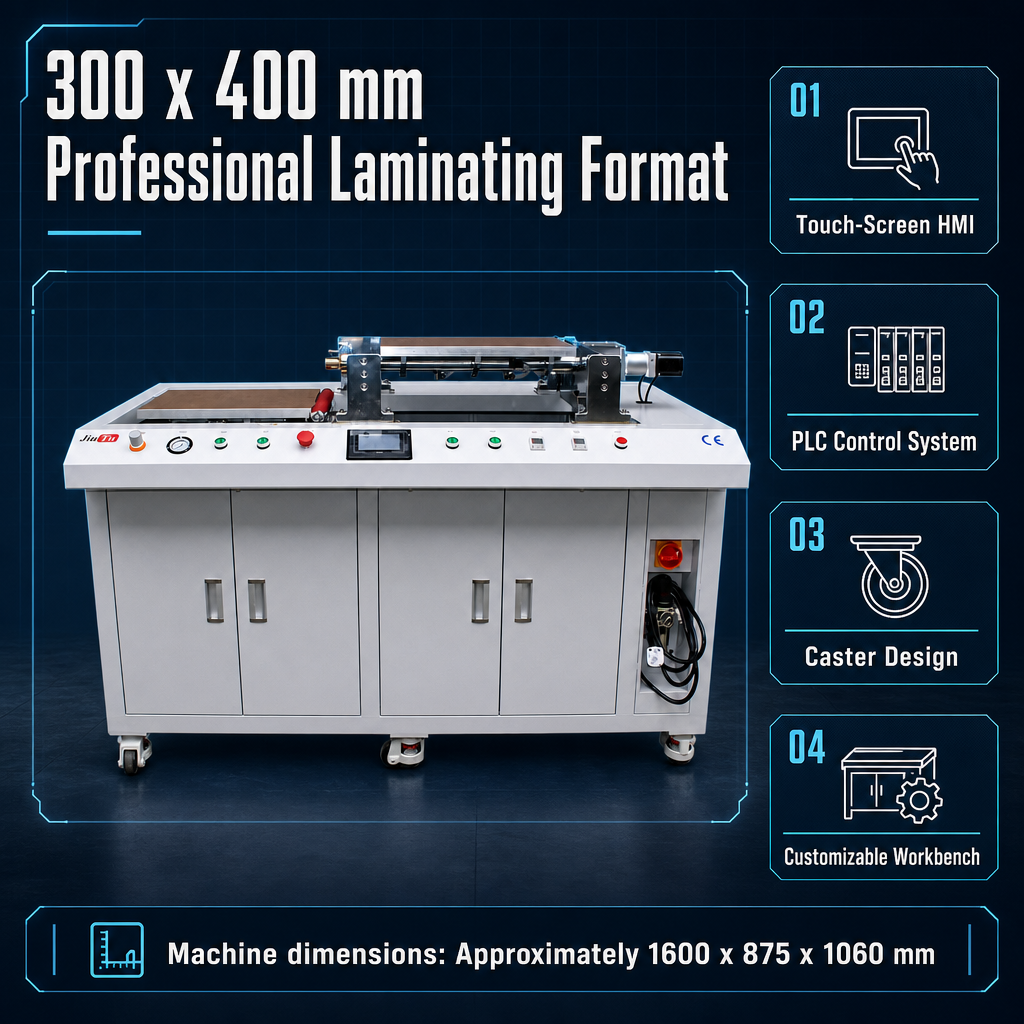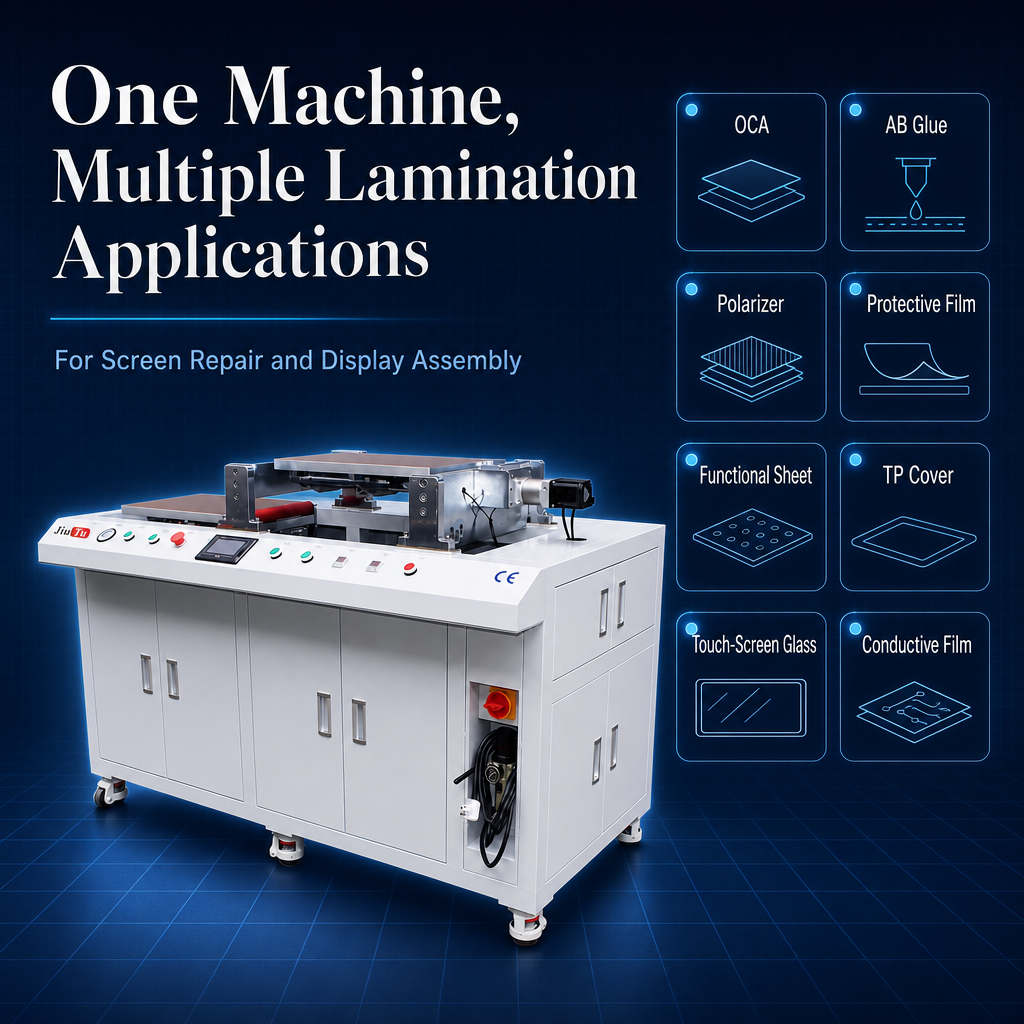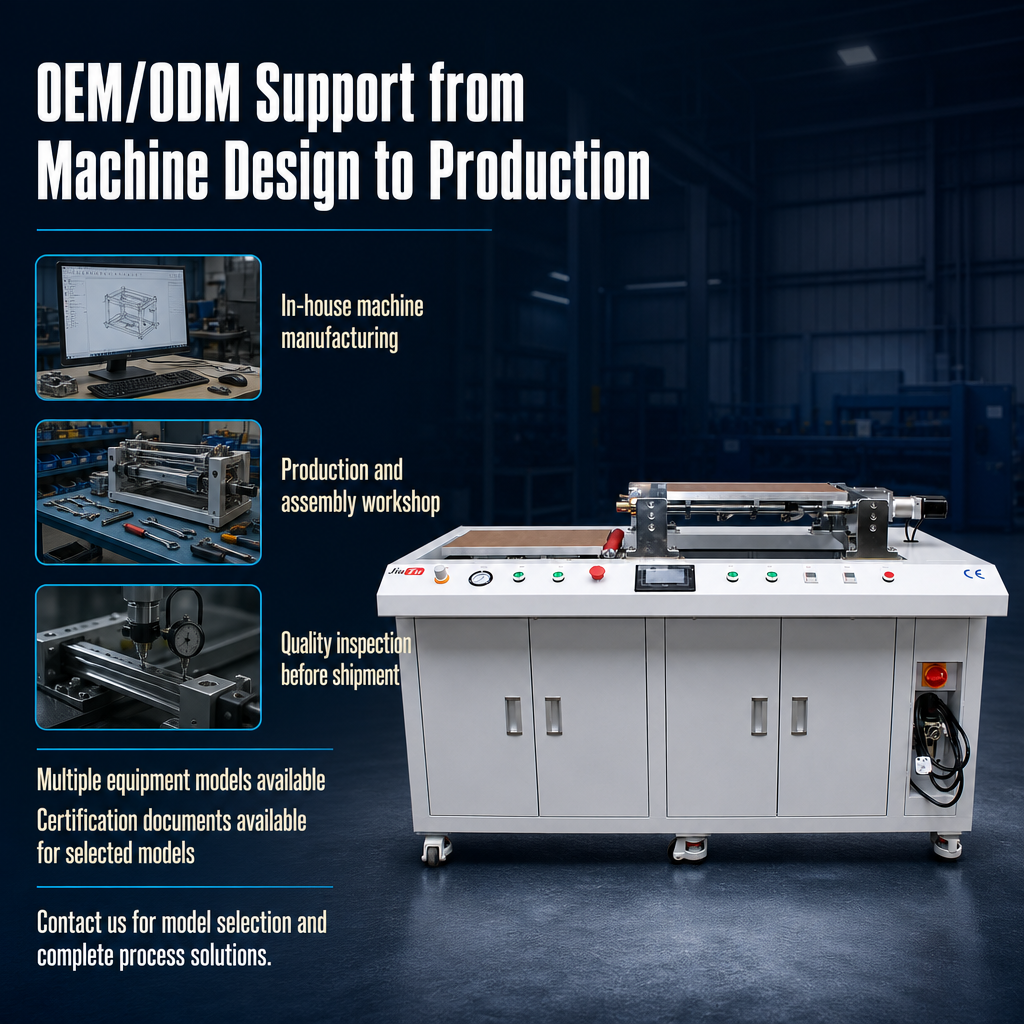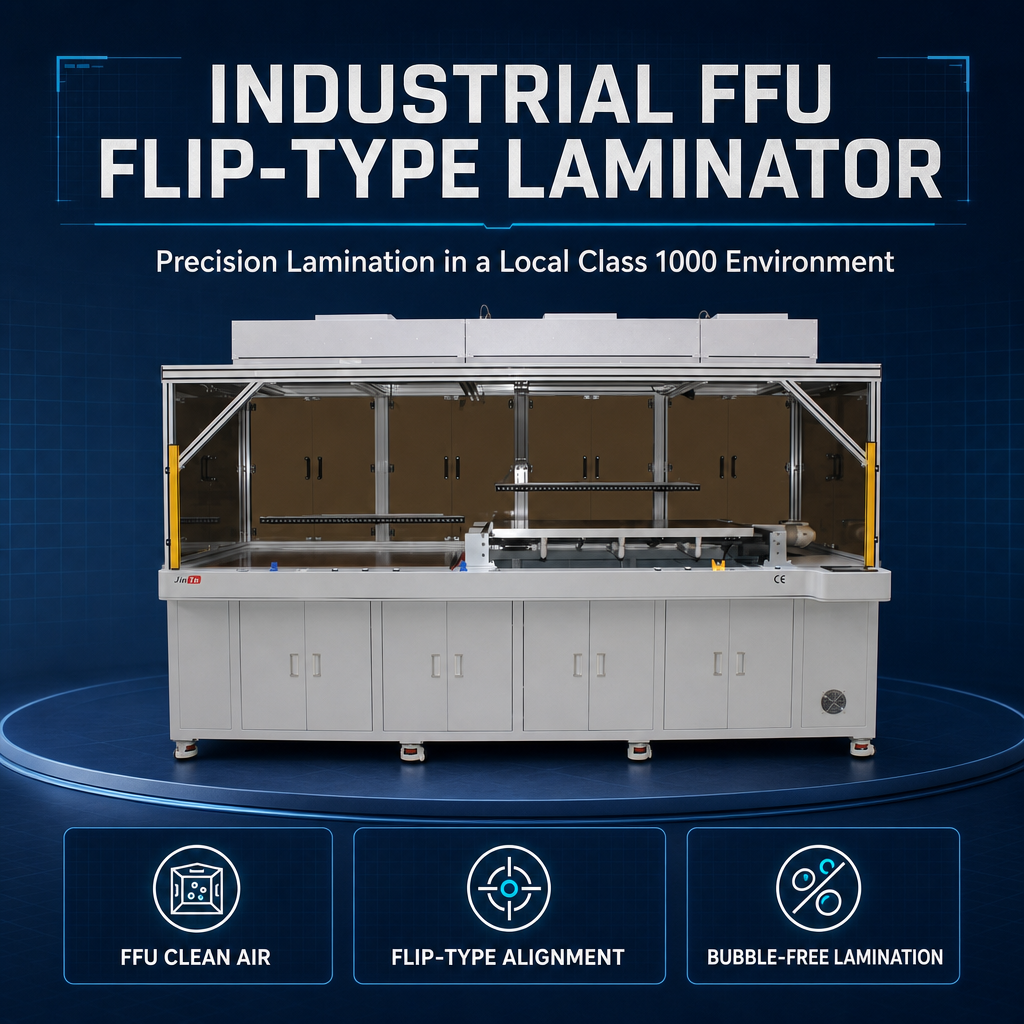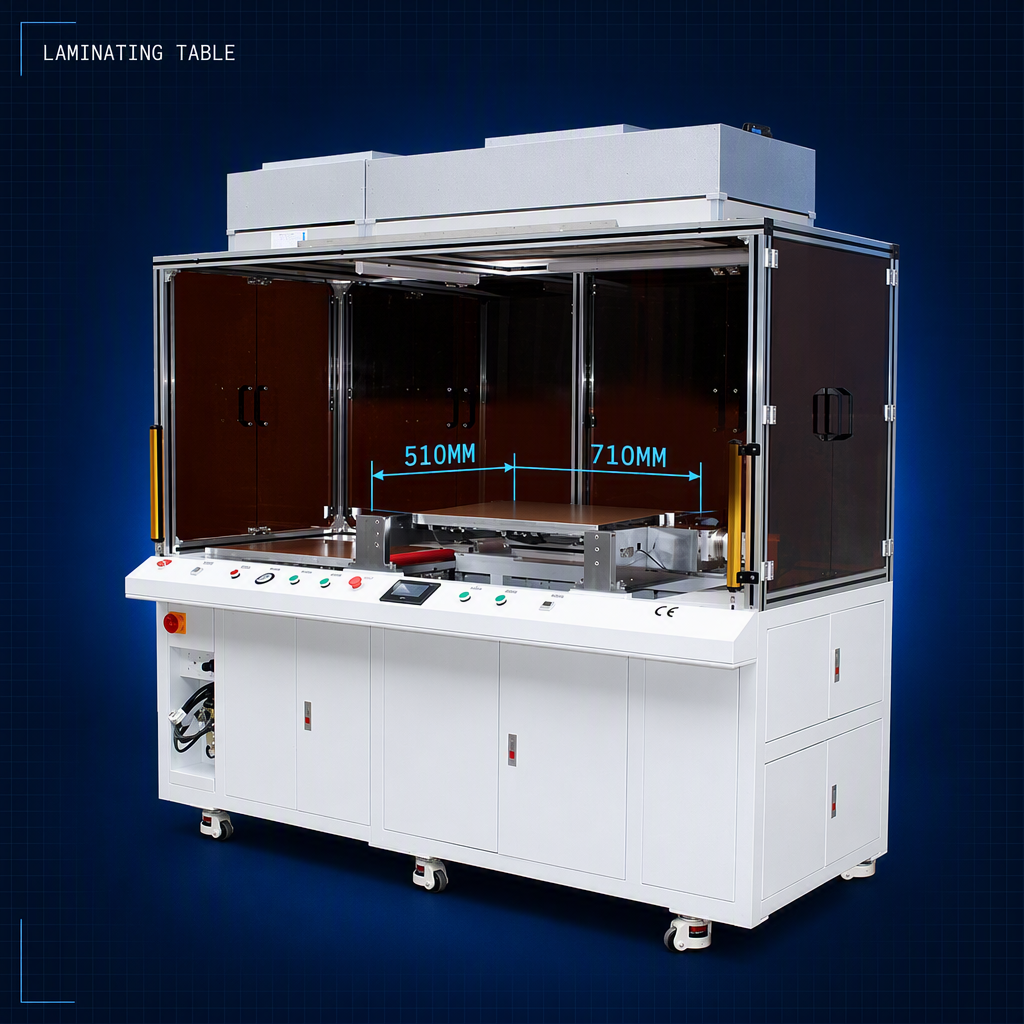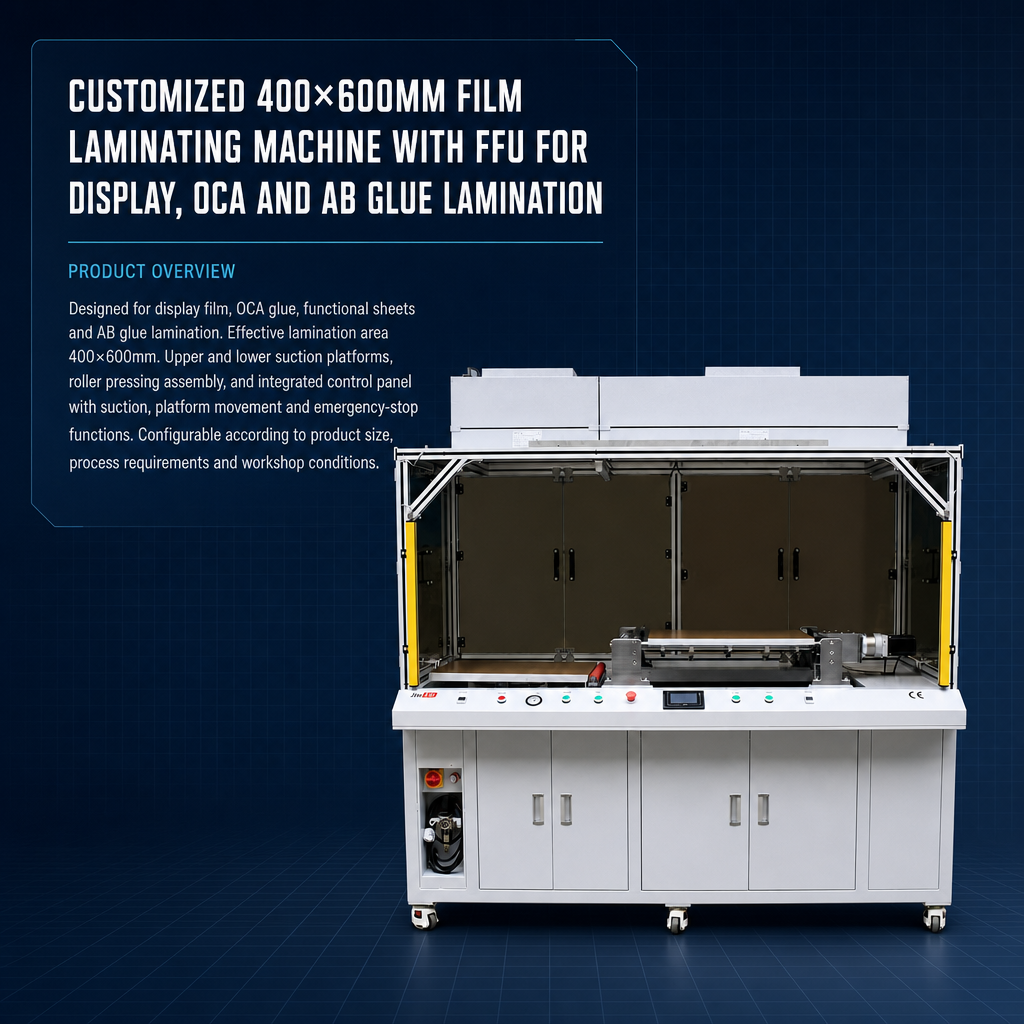
The 300×400 Large-Format Automatic Film Laminating Machine

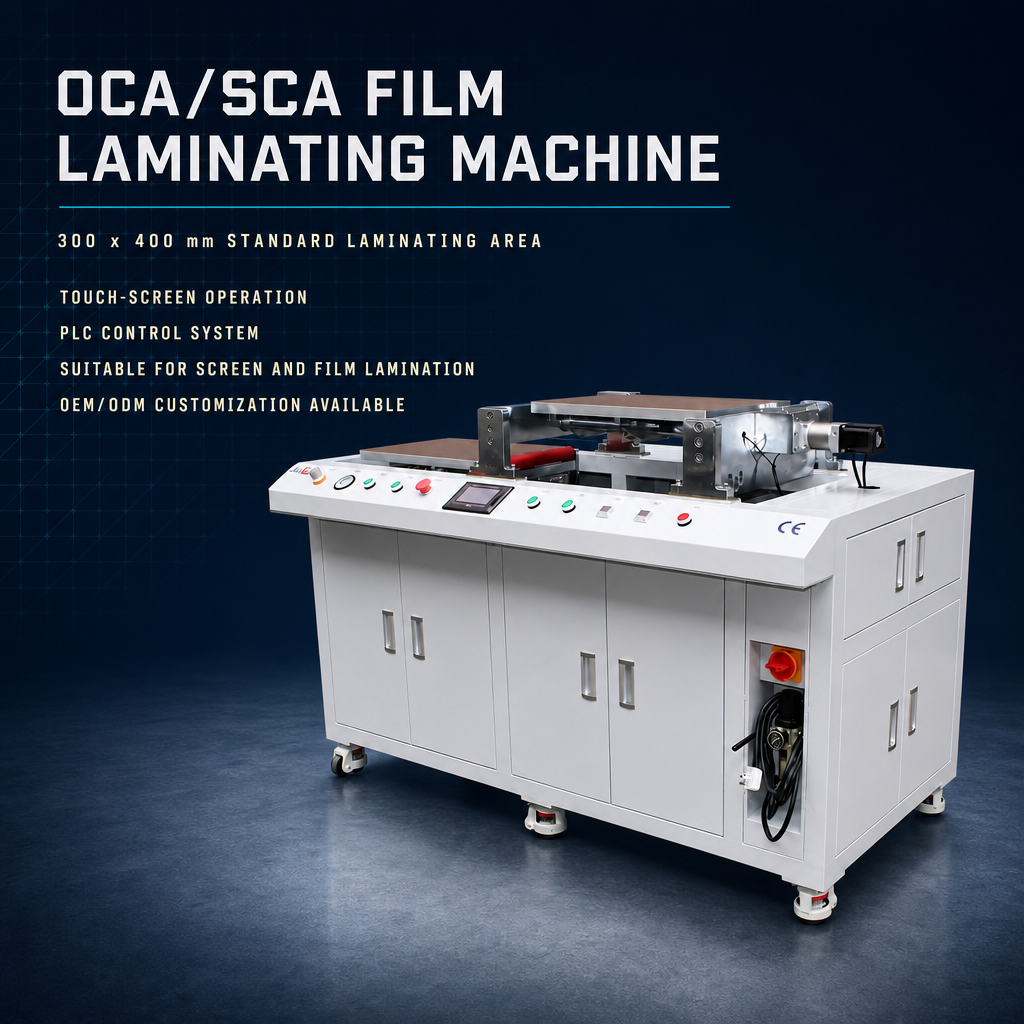
The 300×400 Large-Format Automatic Film Laminating Machine is a production-grade film application system designed for factories engaged in industrial display panel manufacturing, optical bonding, and ...

GET QUOTE NOW
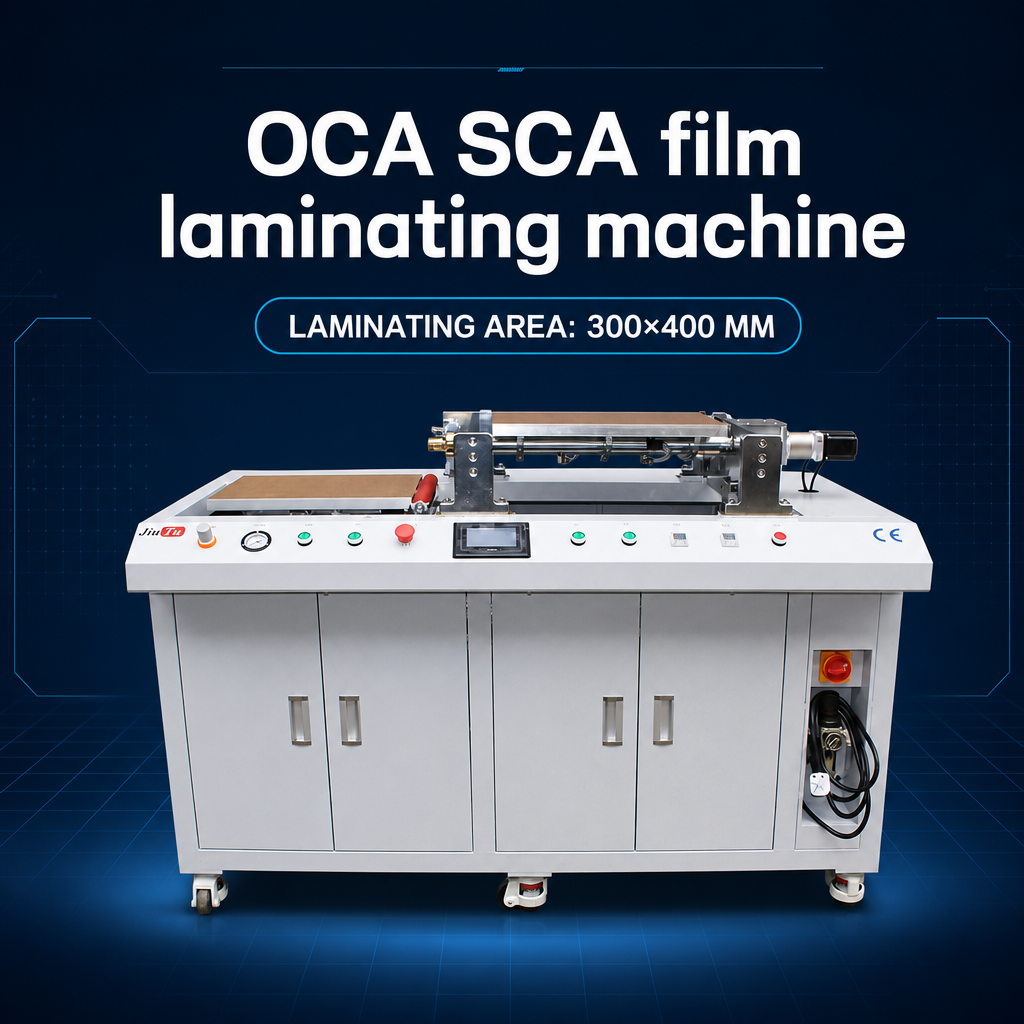
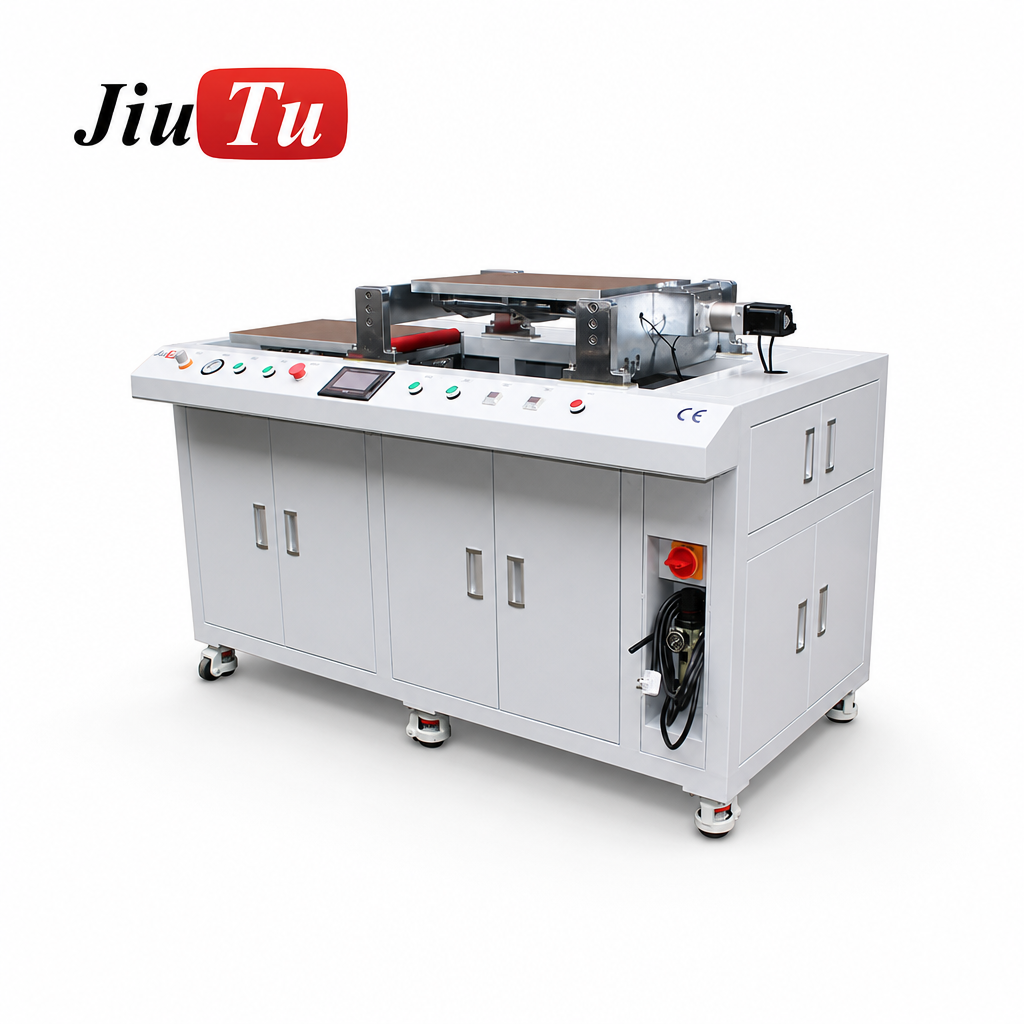
The 300×400 Large-Format Automatic Film Laminating Machine
The 300×400 Large-Format Automatic Film Laminating Machine The 300×400 Large-Format Automatic Film Laminating Machine The 300×400 Large-Format Automatic Film Laminating Machine

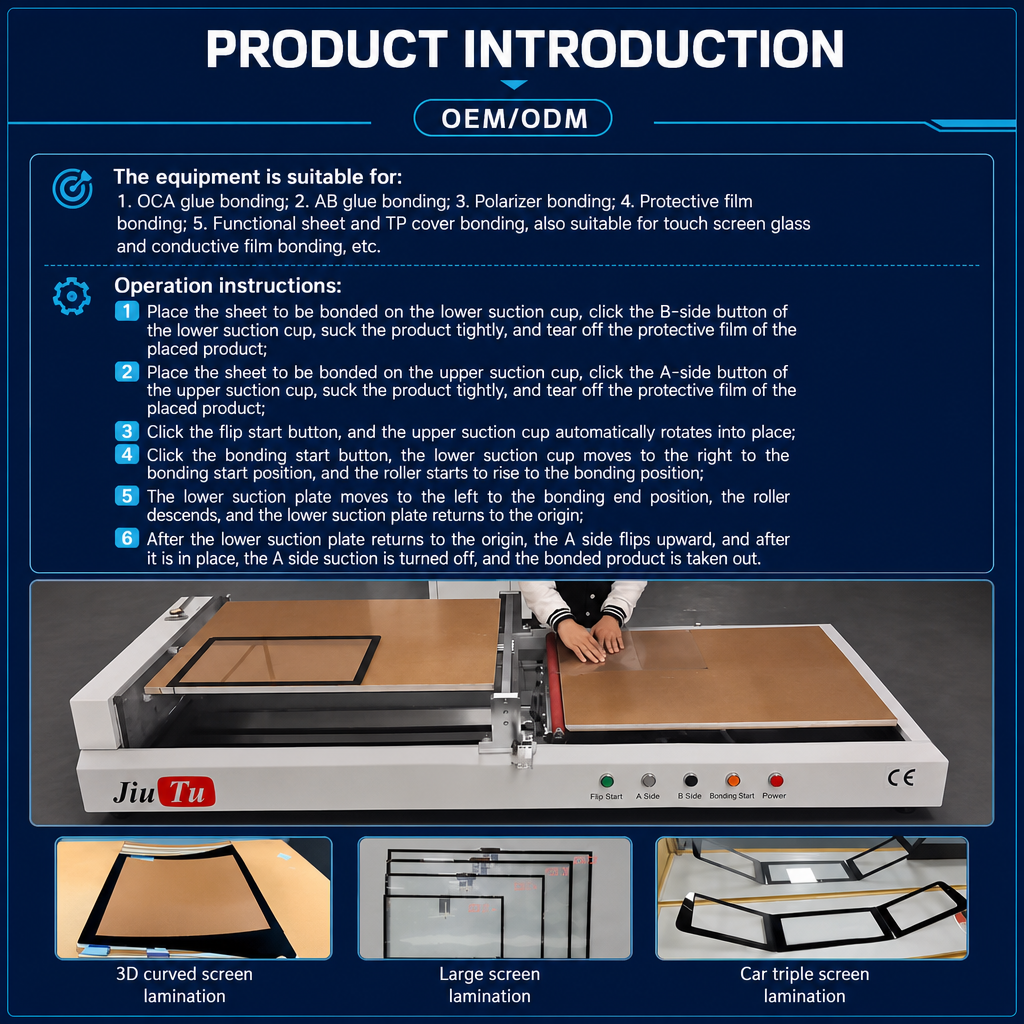
Unlike small-format bench-top laminators used in limited-volume settings, this machine is engineered for continuous, high-throughput factory operation. Vacuum adsorption locks the substrate flat on the work platform, while a pneumatic inflation-shaft roll-feed system delivers precise, consistent film application from reel to panel in a single uninterrupted motion.

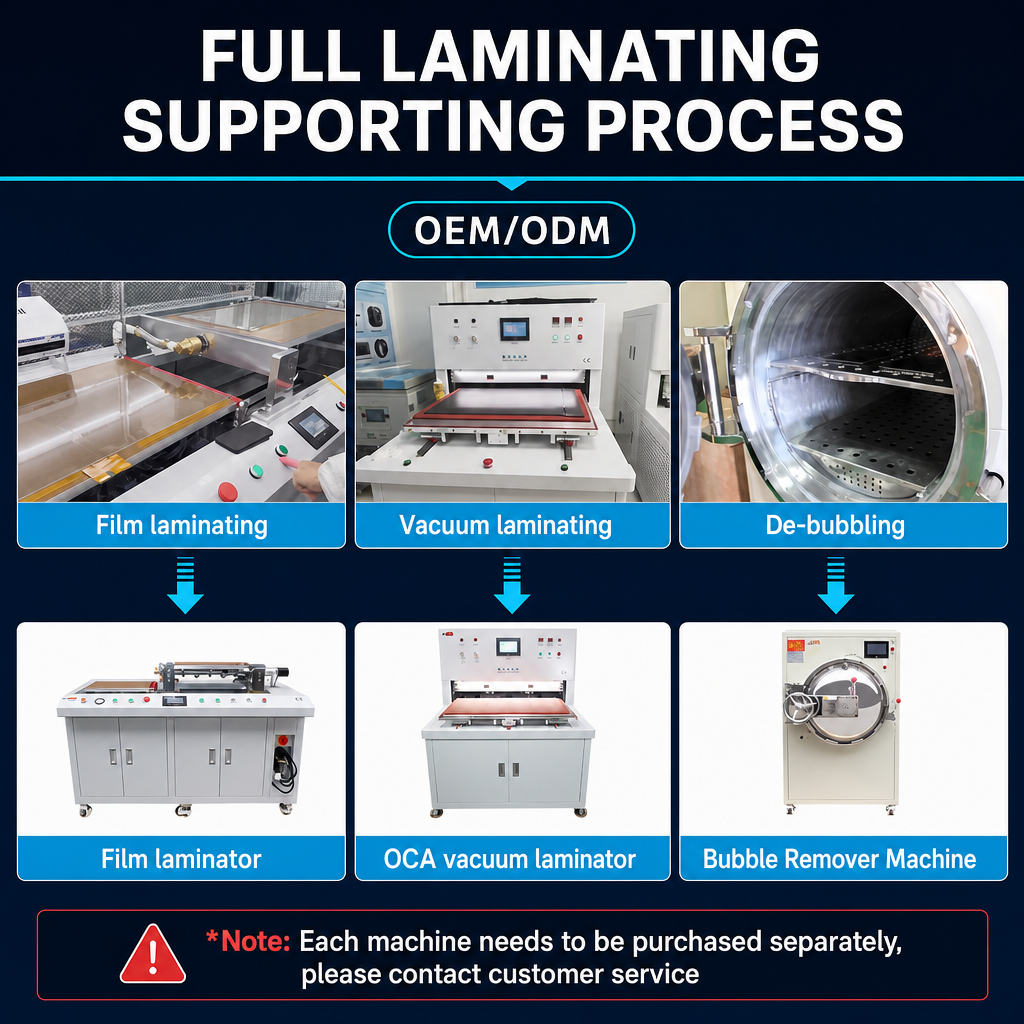
The machine integrates directly as a process station within the standard optical bonding workflow:

Glass Cleaning → Film Lamination (this machine) → Vacuum Full Bonding → High-Pressure Autoclave Defoaming

Compatible Film Types
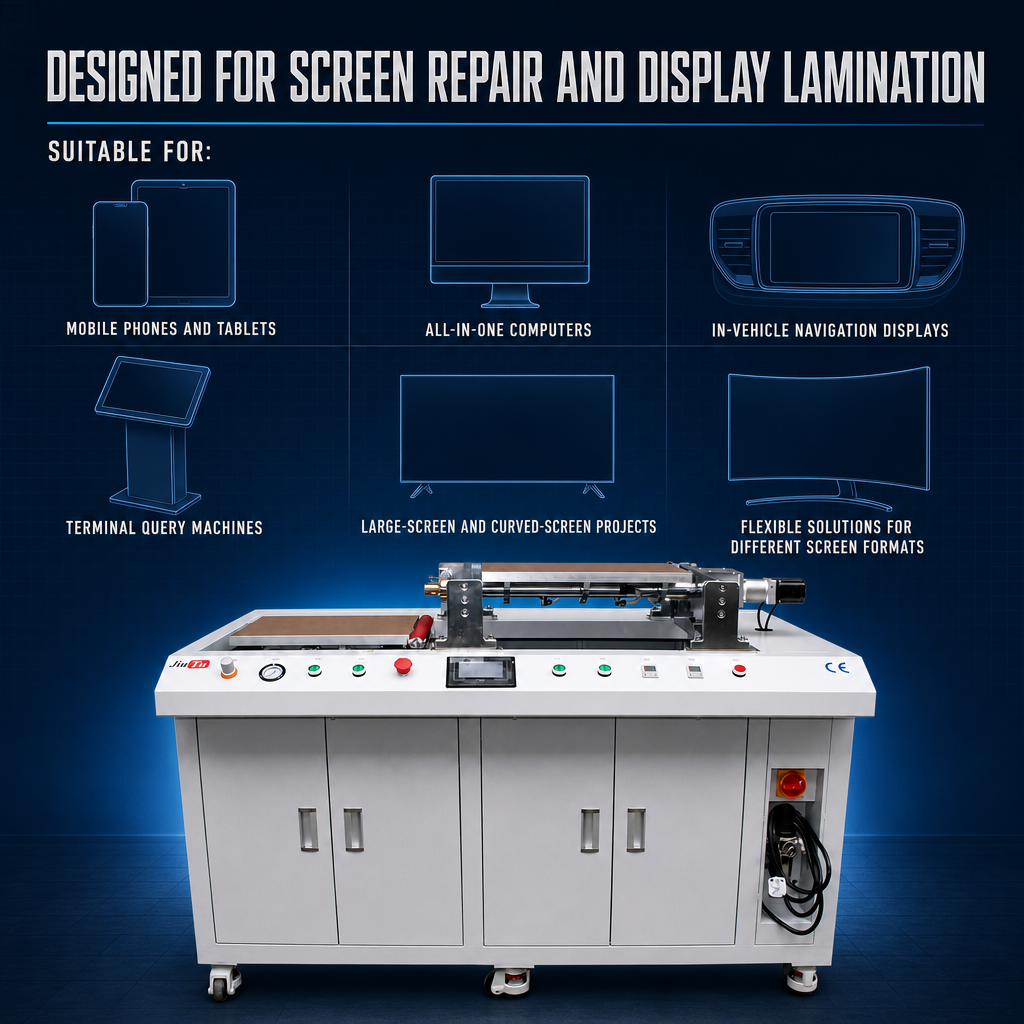
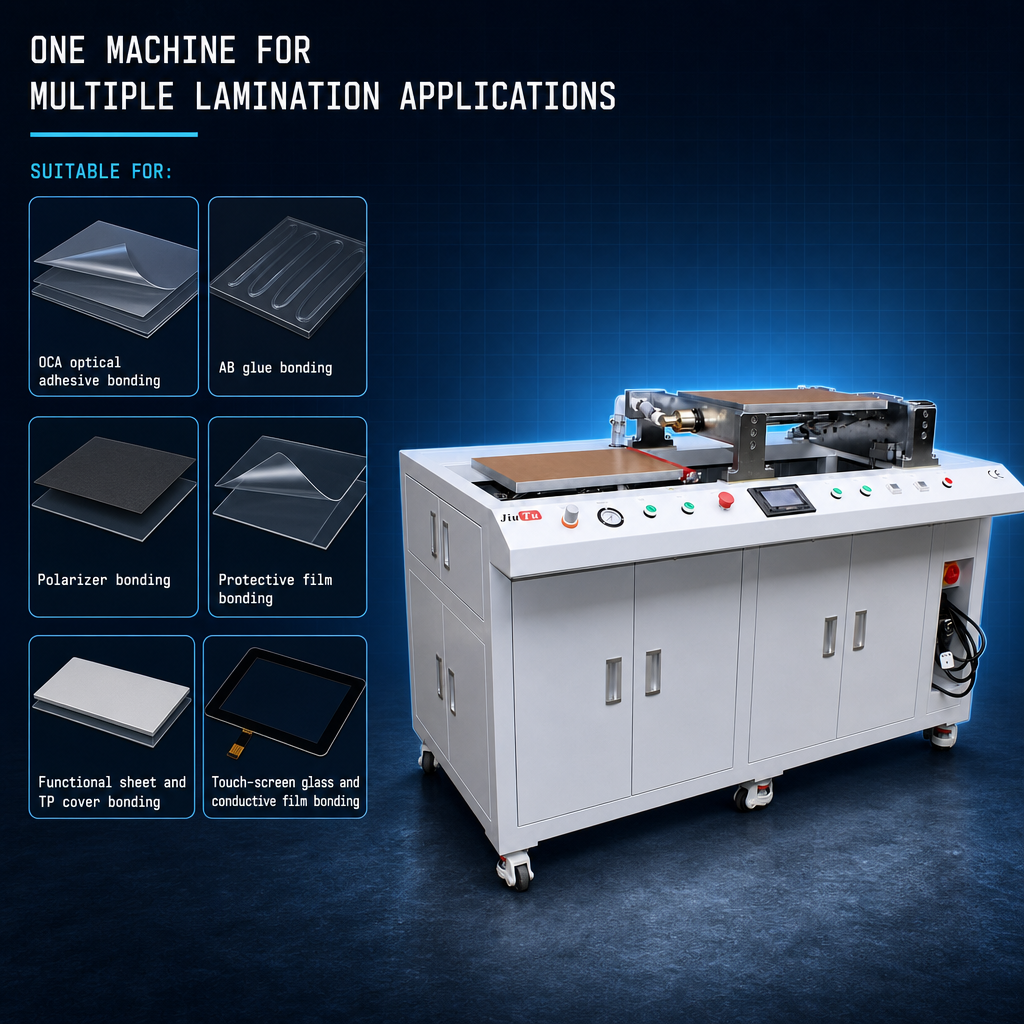
This machine handles all major film types used in industrial display panel production:
Film Type Application in Display Manufacturing
Protective process film In-line production protection during glass and module handling
Anti-explosion / shatter-resistant film Front-face protection for industrial monitors and HMI panels
OCA (Optical Clear Adhesive) film Pre-lamination onto cover glass before full optical bonding (G+G, G+F)
SCA adhesive film Full-bonding adhesive layer for G+G and TP+LCM assemblies
AG film (Anti-Glare) Surface treatment for outdoor and high-ambient-light displays
AR film (Anti-Reflection) Surface treatment for precision display assemblies
AF film (Anti-Fingerprint) Surface treatment for touch-enabled industrial panels
Polarizer (Pol) film Polarizer attachment on LCD panels for industrial and commercial displays

Compatible Substrate Types
Flat cover glass (CG) — tempered and non-tempered
Glass sensor panels (GLASSSENSOR / ITO glass)
LCD modules (LCM) — rigid glass-based assemblies
Touch panel assemblies (TP) — G+G and G+F structures
Composite optical assemblies — pre-bonded CG+OCA prior to full vacuum bonding
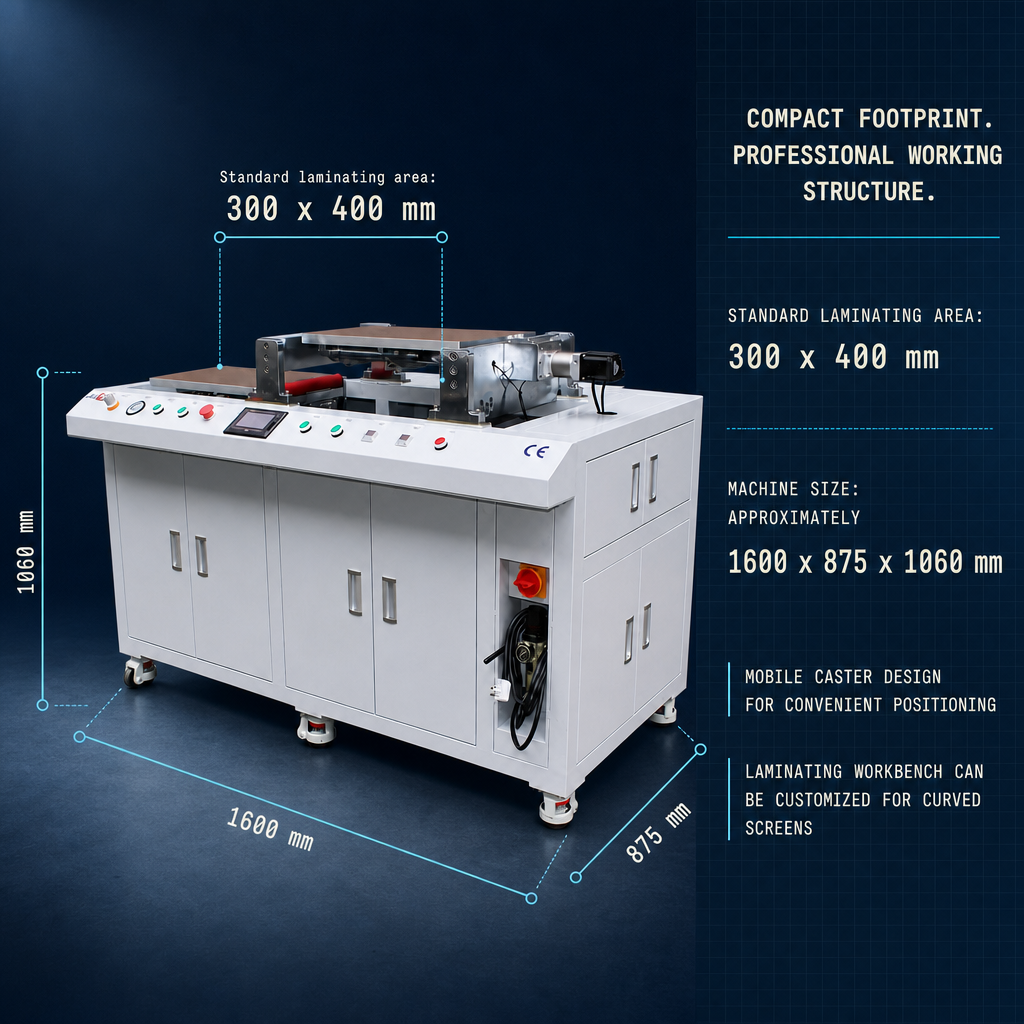
Industrial monitor front-glass panels up to 300 × 400 mm

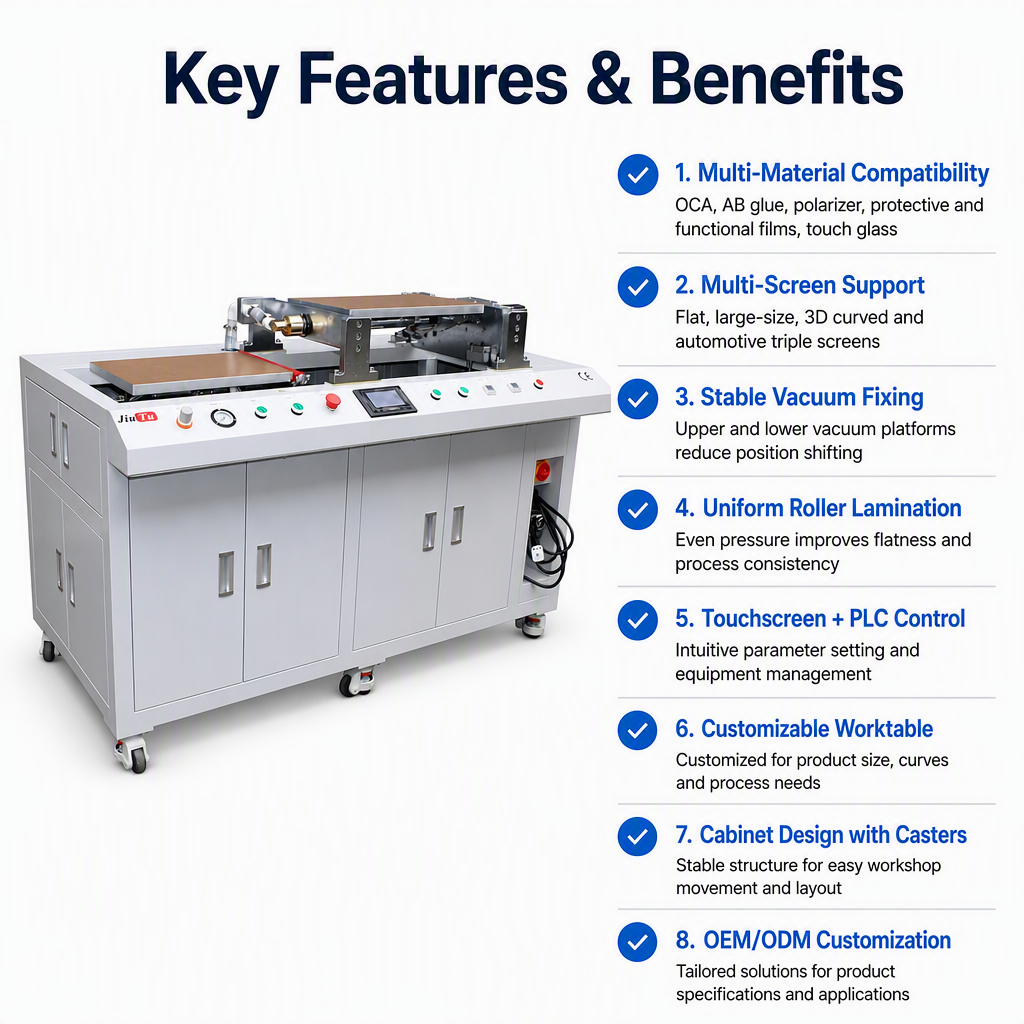
Key Features
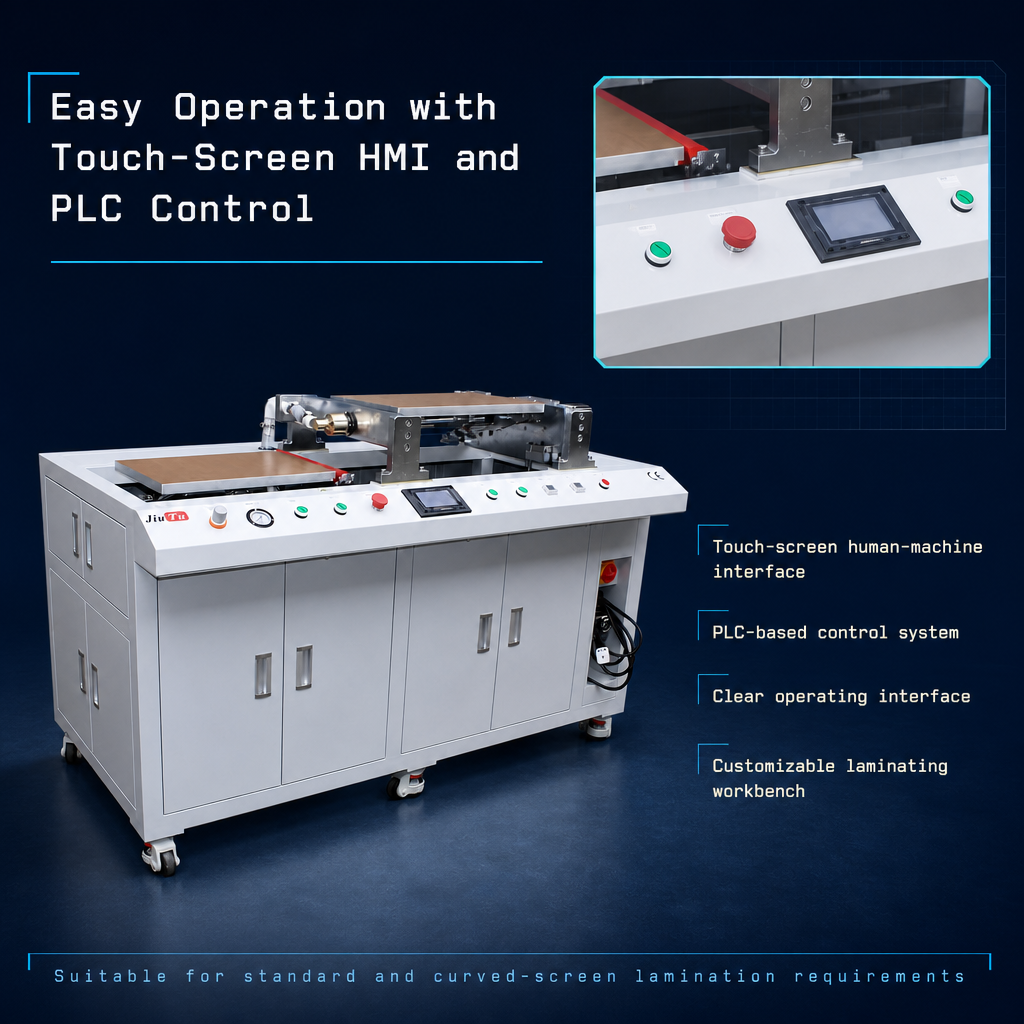
Vacuum Adsorption Work Platform

Vacuum Adsorption Work Platform

The flat-bed vacuum chuck holds the substrate firmly and flush against the work platform throughout the lamination cycle. This eliminates substrate bow, positional drift, and surface-contact contamination that arise from mechanical clamping. It accommodates glass and module substrates across a range of thickness profiles without fixture changes.
Roll-Film Edge-Peel Lamination ("边撕边贴")

Roll-Film Edge-Peel Lamination ("边撕边贴")

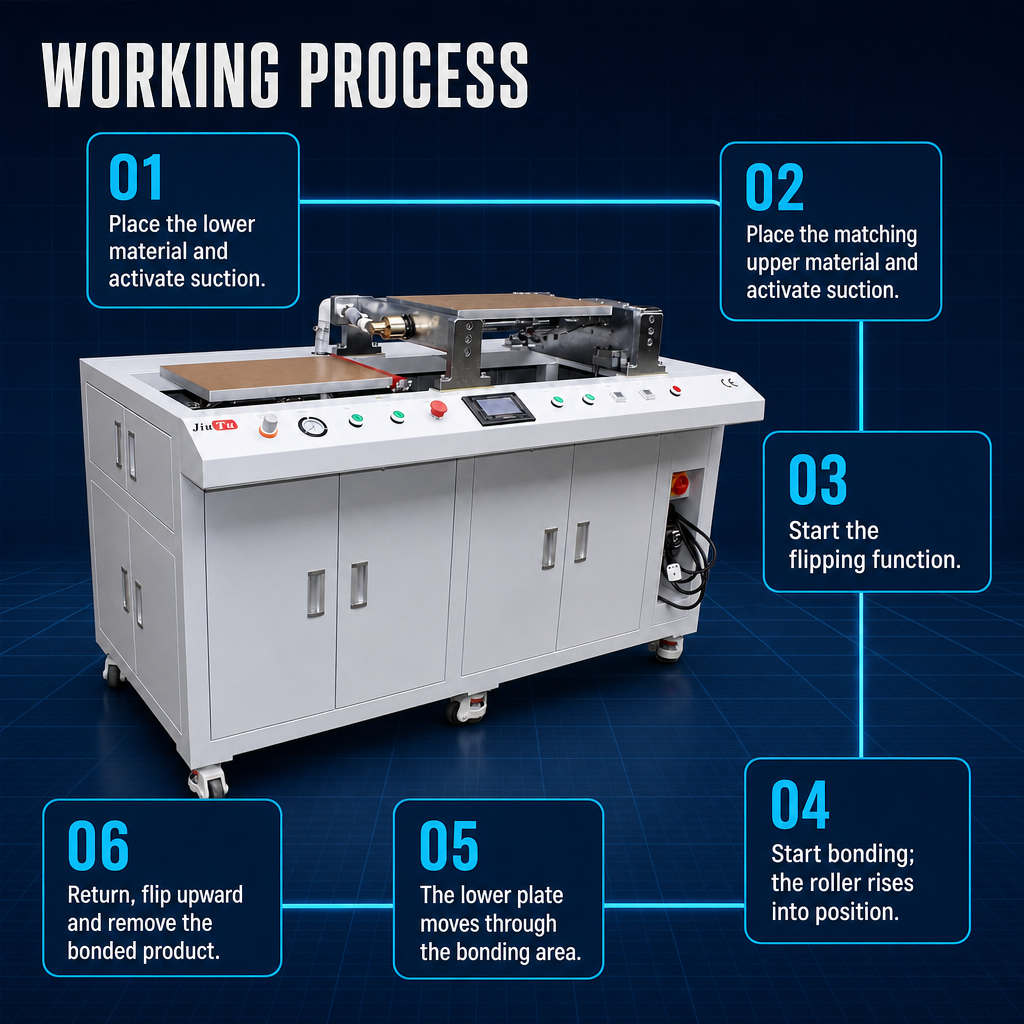
Roll film is loaded onto the pneumatic inflation shaft. As the work platform advances, the film liner is peeled away at a fixed angle while the exposed adhesive surface is simultaneously applied to the substrate surface. The pressure roller follows immediately behind the peel point, expelling any entrapped air ahead of the bond line.
This process eliminates the need to pre-cut film to panel size, reduces material waste, and produces a bubble-free bonding interface on every cycle.
Precision Pneumatic Roller Pressure

Precision Pneumatic Roller Pressure

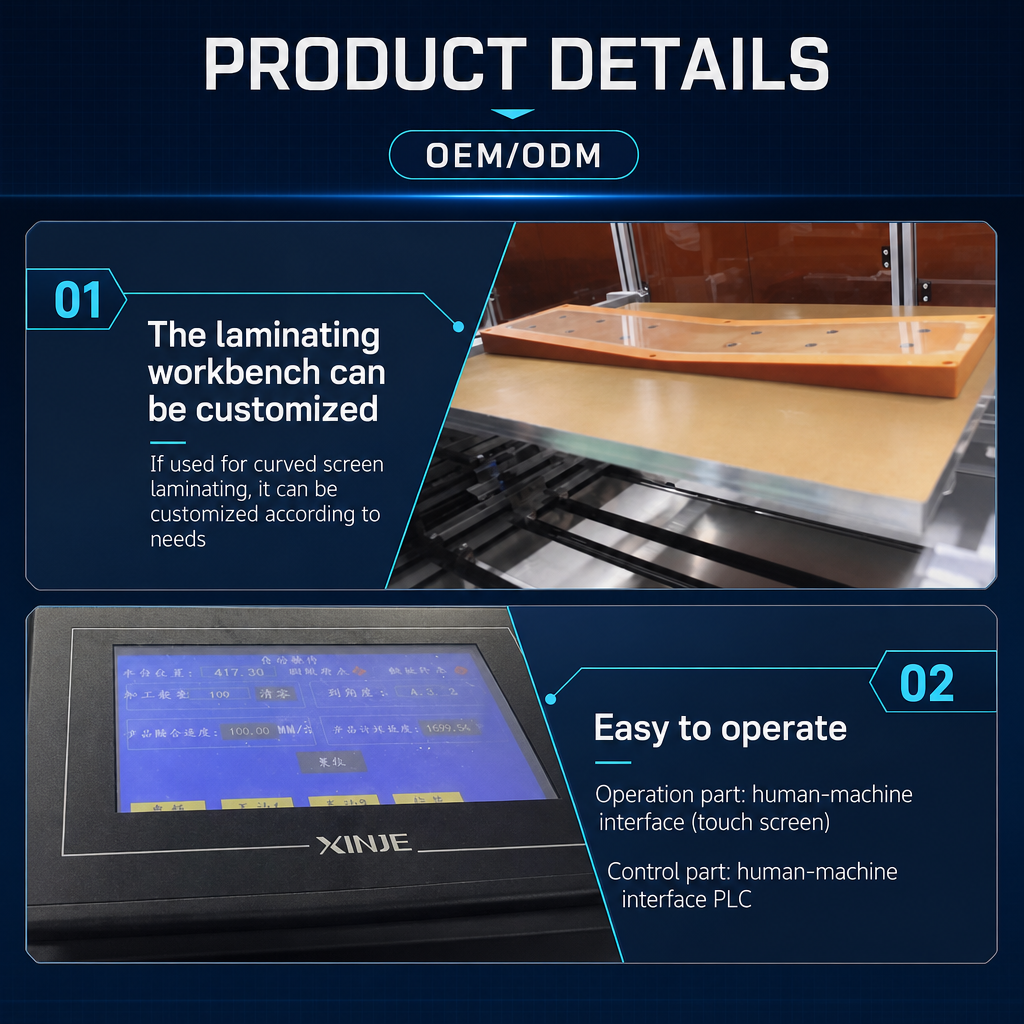
A precision air pressure regulator controls the roller pressing force applied to the film during lamination. The pressure is independently adjustable to match the mechanical requirements of different film types — thin functional films, thicker OCA optical adhesive sheets, and rigid anti-explosion films all require different roller force profiles. Adjustable pressure prevents substrate cracking and film deformation across the full range of compatible materials.
PLC Programme Control with Multi-Recipe Storage

PLC Programme Control with Multi-Recipe Storage

The machine is controlled by a PLC (Programmable Logic Controller) with a colour touchscreen HMI. All process parameters — platform advance speed, roller pressure, vacuum hold duration, and film feed length — are stored as named recipes. Operators select the recipe for the current panel type and the machine executes the cycle repeatably without manual adjustment between panels.
Mechanical Registration Positioning

Mechanical Registration Positioning

Substrate position is established by mechanical guide rails and locating stops before each cycle begins. The system sets X-axis and Y-axis position repeatably, ensuring consistent film placement relative to the substrate edge across the entire production batch.
Pneumatic Inflation-Shaft Film Spool System

Pneumatic Inflation-Shaft Film Spool System

The roll-film spool holder uses a pneumatic inflation shaft that expands to grip the film core when pressurised and releases for roll changeover when depressurised. This allows fast, tool-free roll changeover between film types and eliminates spool slippage during high-speed feeding.

Why Choose Us
Key Advantages for Industrial Display Factories Key Advantages for Industrial Display Factories Key Advantages for Industrial Display Factories Key Advantages for Industrial Display Factories Key Advantages for Industrial Display Factories Key Advantages for Industrial Display Factories Key Advantages for Industrial Display Factories Key Advantages for Industrial Display Factories Key Advantages for Industrial Display Factories

Key Advantages for Industrial Display Factories

Consistent output at industrial throughput rates
Mechanical registration and PLC-controlled cycle execution deliver the same result on every panel regardless of operator skill level or shift fatigue. This consistency directly translates to lower rework rates and more predictable line yield.

Broad film compatibility from a single platform
One machine covers the full range of film types used in a typical industrial display production line — process protection, optical functional films, and OCA/SCA adhesive films. Switching film types requires only a roll change and a recipe recall, with no mechanical reconfiguration.

Designed as part of the optical bonding process chain
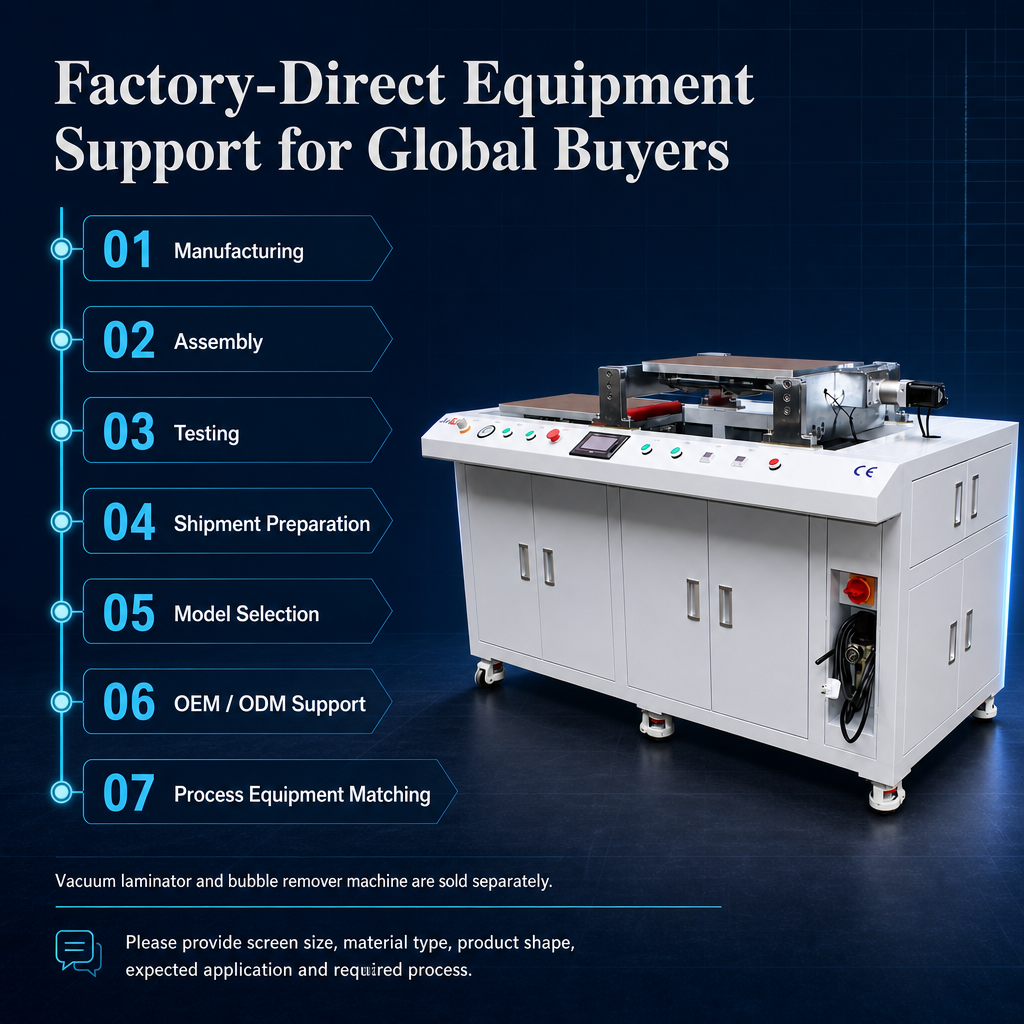
The 300×400 laminator is sized and specified to feed directly into vacuum full-bonding and autoclave defoaming stages. It is not a standalone bench machine — it is a process station within an integrated production line. Its output format (film pre-laminated glass or OCA-coated cover glass) matches the input format required by downstream bonding equipment without intermediate handling steps.

Sized for industrial panels, not compact products
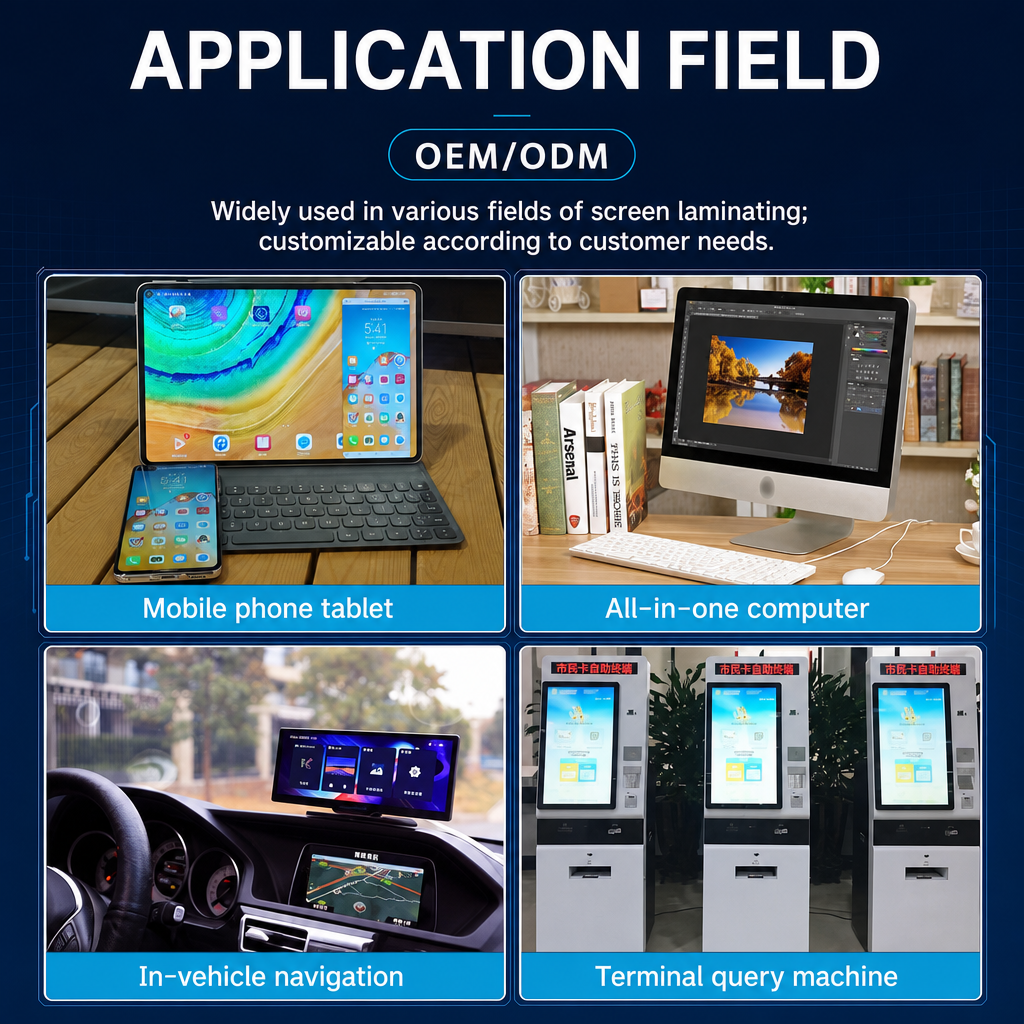
The 300 × 400 mm working area addresses the display sizes used in industrial monitors, HMI panels, and vehicle-mounted displays — typically in the 12-inch to 18-inch range. This platform scale is not available on small-format laminators and fills a specific gap in the mid-size industrial panel manufacturing equipment segment.

Product Documents

Key Features
The 300×400 Large-Format Automatic Film Laminating Machine The 300×400 Large-Format Automatic Film Laminating Machine The 300×400 Large-Format Automatic Film Laminating Machine The 300×400 Large-Format Automatic Film Laminating Machine The 300×400 Large-Format Automatic Film Laminating Machine The 300×400 Large-Format Automatic Film Laminating Machine The 300×400 Large-Format Automatic Film Laminating Machine The 300×400 Large-Format Automatic Film Laminating Machine

Product Details

FAQ

Q1: What types of film can this machine apply?
A: The 300×400 Large-Format Film Laminating Machine is compatible with all major industrial display film types:Protective process film — polyester or polypropylene films applied during production to protect panel surfaces from scratches and contamination Anti-explosion / shatter-resistant film — thick security films for industrial panel front-face protection OCA (Optical Clear Adhesive) film — solid optical adhesive film pre-applied to cover glass before full optical bonding SCA adhesive film — silicone optical clear adhesive used in G+G and G+F bonding processes AG / AR / AF optical functional films — anti-glare, anti-reflection, and anti-fingerprint surface treatment films Polarizer (Pol) film — polarizing layer film applied to LCD panels All film types use the same edge-peel roll-feed lamination process. Different films require different roller pressure settings, which are stored as separate PLC recipes and recalled by the operator at the start of each production run.
Q2: What is the maximum panel size this machine handles?
A: The effective working platform measures 300 mm × 400 mm. This accommodates rectangular display panels up to approximately 15 to 18 inches diagonal, depending on aspect ratio.For reference:A 15.6" widescreen panel (16:9) is approximately 345 × 194 mm — within platform capacity A 15" square-format industrial panel (4:3) is approximately 305 × 228 mm — within platform capacity An 18.5" widescreen panel is approximately 409 × 230 mm — this exceeds the 400 mm length dimension For panels exceeding 18 inches, please enquire about larger-platform models. For panels below 12 inches, this machine operates without modification — the vacuum chuck secures smaller substrates across the full platform area.
Q3: How does edge-peel lamination prevent bubbles?
A: Bubble formation during film lamination occurs when air is sealed between the film adhesive and the substrate surface before it can escape. The edge-peel process prevents this through three simultaneous actions:Progressive application from one edge: The film is never placed flat onto the substrate all at once. It bonds progressively from one edge to the opposite edge, so air ahead of the bond line always has a free path to exit at the advancing edge.Immediate roller consolidation: A pressure roller follows directly behind the peel point, pressing the freshly bonded film against the substrate surface. Any residual air between film and substrate is mechanically driven toward the open edge and expelled before the bond can seal it in.Flat substrate fixation by vacuum: The vacuum chuck holds the substrate completely flat. Any substrate bow or surface waviness would create trapped air pockets at the bonding interface. Vacuum fixation eliminates this source of bubble formation before the film touches the substrate.For applications requiring zero-bubble optical bonding — such as TP+LCM full bonding for industrial touch displays — this lamination step is followed by vacuum full bonding and high-pressure autoclave defoaming, which eliminate any micro-bubbles that form during subsequent handling.
Q4: What panel thickness range is compatible with the vacuum platform?
A: The vacuum adsorption platform is compatible with rigid glass and glass-based module substrates in the thickness range typically used in industrial display manufacturing. This includes:Single glass sheets (cover glass): 0.7 mm – 4 mm LCM modules with back-frame: typically 3 mm – 10 mm total assembly height Composite assemblies (pre-bonded CG + partial stack): substrate-dependent The vacuum chuck does not apply mechanical clamping force to the substrate edges, so thin glass and pre-bonded assemblies with surface-mounted components are not at risk of edge cracking from the registration system.For substrates outside the standard range, please confirm dimensions with our sales team before ordering.
Q5: What film roll specifications does the machine accept?
A: The machine uses a pneumatic inflation shaft as the film spool holder. Compatible roll film must meet the following general requirements:Roll width: matching or slightly wider than the substrate width (up to 300 mm for the standard platform) Core inner diameter: standard 76 mm (3-inch) core or 152 mm (6-inch) core — confirm at order Film edge registration: edge-located positioning holes are required along one or both film borders; these engage with the film-feed mechanism to control advancement pitch and ensure consistent registration between cycles Film thickness: 0.05 mm – 0.5 mm Sheet-cut film (individual panel-size pieces) is not compatible — the machine is designed for continuous roll-fed production only.
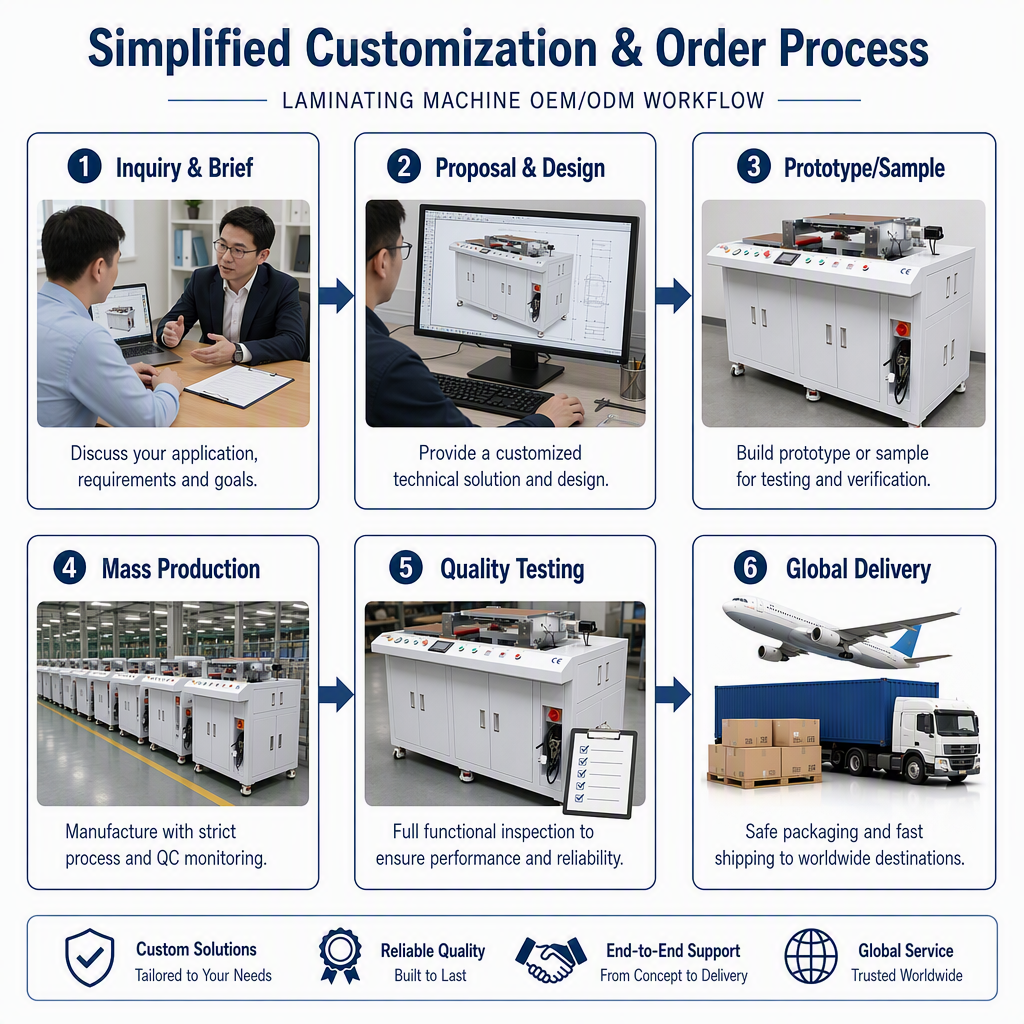
Q6: Is OEM or custom-specification ordering available?
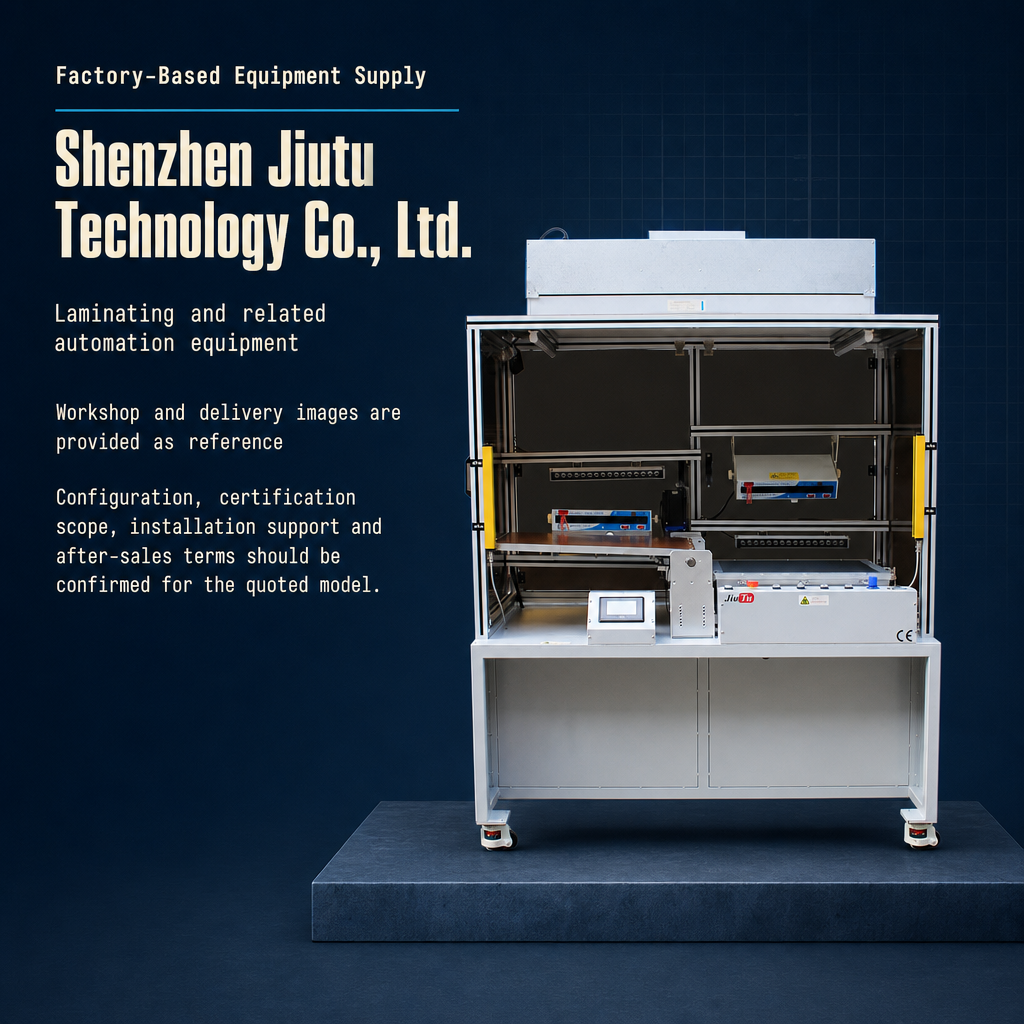
A: Yes. We accept OEM and ODM orders for customers requiring non-standard specifications. Common customisation options include:Platform size: Extended working areas (e.g., 400×600 mm, 500×700 mm) for larger panel formats Film spool configuration: Custom core diameter, dual-spool setup, or wider roll width Roller pressure range: Extended pressure range for specialty adhesive films Platform surface: Custom vacuum zone layout for non-rectangular substrates or panels with back-frame protrusions Enclosure options: Integrated clean-room enclosure or laminar-flow hood for CLASS 100 environments Lead time and minimum order quantity for OEM configurations vary by specification. Please submit your requirement drawing and target specification to our sales team for a feasibility assessment and quotation.

Interested in This Product?

Tell us your project details and our team will prepare a customized quotation.

GET QUOTE NOW
Contact Us