
Imagine a display manufacturer adding a new cover-glass assembly to an existing OCA lamination line. The panel fits the current machine, but the new design specifies a liquid optical resin rather than an adhesive film. Is a different laminator necessary, or can the factory keep its existing equipment and add a dispensing and curing stage?
That is the practical difference between an OCR bonding machine and an OCA laminating machine. OCA (optically clear adhesive) is commonly supplied as a preformed film. OCR (optically clear resin), often discussed alongside LOCA (liquid optically clear adhesive), forms the adhesive layer during production. While the two routes share some assembly functions, the liquid process introduces questions about how the resin is applied, how its thickness is controlled and how it is cured.
For LCD, OLED and touch-display manufacturers, the answer affects more than the price of the bonding machine. It can change the layout of the production line and determine whether existing equipment is worth keeping.
Why the Display Design Changes the Equipment Choice
Consider two displays with similar outer dimensions. One has a flat cover glass and an uninterrupted bonding surface. The other has a stepped edge or an opening near a connector. With OCA, a film can be prepared to match the bonding area. With liquid resin, the same boundary has to be managed while the adhesive spreads between the substrates.
The second design may therefore be more demanding even though it fits on the same machine platform. A fixture that adequately supports a flat panel might not maintain the intended gap across a stepped assembly. Likewise, a dispensing pattern that works for one resin may behave differently with another viscosity or working time.
This is where the resin data sheet and the display drawing complement each other. The former describes the material’s processing conditions; the latter shows how those conditions interact with the shape of the workpiece.
Panel size is only part of the fit. A panel that fits the working platform can still need different tooling if the bonding gap or the clearance around a connector changes.
If the material itself is still under consideration, our comparison of OCA, SCA and LOCA materials explains the wider trade-offs between the bonding routes.
Why Does Liquid Resin Change the Equipment Scope?
On an OCA line, the adhesive arrives with its thickness and shape largely established. Film handling, alignment and lamination bring that layer into contact with the display surfaces. Where residual bubbles warrant additional treatment, an autoclave or bubble remover can follow the laminator.
An OCR line creates the bond line from liquid adhesive instead. Resin preparation may precede dispensing, and the assembly is subsequently cured according to the material’s formulation. A vacuum laminator might perform part of that workflow, but the other operations are just as important to the finished display.
The following comparison shows where the equipment requirements diverge.
| Process area | OCA film lamination | OCR liquid resin bonding |
|---|---|---|
| Adhesive application | Preformed film is positioned on the intended bonding surface. | Controlled dispensing or another supplier-approved application method. |
| Bonding control | Alignment, support, vacuum and pressing conditions suited to the film stack. | Resin movement and bond-line geometry in addition to assembly control. |
| Material behaviour | Film contact, handling condition and adhesive conformity are central concerns. | Dispensing quantity, flow, coverage and overflow control. |
| Curing and treatment | Any additional treatment follows the selected adhesive’s process specification. | Curing equipment or integrated curing functions suited to the resin. |
| Supporting equipment | Film preparation and bubble removal equipment where required. | Resin preparation, dispensing and curing equipment where required. |
Whether these operations belong in one machine or several depends partly on production volume and partly on the material. An integrated arrangement can reduce transfers, while a separate curing station may allow another assembly to enter the bonding machine without waiting for the previous one to cure. The advantage disappears if the uncured resin moves excessively during transfer or the material’s processing window is exceeded.
For a film-based project, JiuTu’s OCA vacuum laminating machines are a useful starting point. In an OCR project, the same type of equipment may represent only the assembly portion of the investment. A cheaper laminator is not necessarily the cheaper production line.
How Dispensing and Curing Affect the Production Line
The reasons for separating these functions become clearer when looking at what can happen to the adhesive during production.
A repeatable dose is not always a repeatable bond line
Suppose a dispensing system delivers the same amount of resin to every panel. If the fixture allows the glass to sit at a slightly different angle or the bonding gap varies, that repeatable dose can still produce uneven coverage. Adding more resin may simply push adhesive into an area that was intended to remain clear.
This is particularly relevant to stepped cover glass and assemblies with openings. Changing the dispensing pattern may help the resin reach the intended areas, but the tooling also influences how the gap develops as the layers meet. In such a project, spending more on dispensing precision alone may offer little benefit if the assembly stage cannot control the bond-line geometry.
The supply system plays a role as well. A resin whose viscosity changes with temperature, or whose working time limits how long it can remain in process, may favour a different material-handling arrangement. Preparation or degassing, when specified by the supplier, also affects how consistently material reaches the dispensing station.
Why curing affects more than the choice of a lamp or heater
A UV-curable resin may seem straightforward to incorporate until the cover glass includes an opaque border. Light that reaches the exposed centre of the display may not reach adhesive beneath the border. Even a suitable UV source can leave some regions inadequately exposed if the optical path or fixture obstructs it. A different exposure arrangement or a compatible alternative curing route may be worth evaluating with the resin supplier.
Thermal curing presents a different trade-off. The adhesive may have a recommended temperature and dwell time that the display’s optical films or connectors cannot tolerate. In that situation, a higher maximum heating temperature on a laminator does not make it a better choice. The relevant question is whether the complete stack can tolerate the actual curing cycle.
Separate curing equipment may be attractive when the cure takes longer than assembly, but the benefit depends on the ability to transfer and support the uncured stack. That is why equipment layout and material selection are closely related in liquid bonding.
What a sample can reveal: A representative display can reveal defects that are not visible on a flat resin test coupon, including incomplete coverage near an opening or changes in the bond line after transfer.
Comparing the assembly before and after curing is particularly useful when deciding whether to retain existing tooling. Coverage and appearance can be assessed alongside the functional acceptance criteria for the finished display.
Can an Existing OCA Laminator Be Used for OCR?
For a factory that already owns an industrial laminator, replacing it simply because the adhesive has changed may be unnecessary. The assembly stage is a sensible place to investigate reuse, especially if the machine can accommodate the new fixture and control how the layers come together. JiuTu’s 9TU-M040D offers a useful example of what can be learned from an actual equipment specification.
Industrial Lamination Equipment Reference
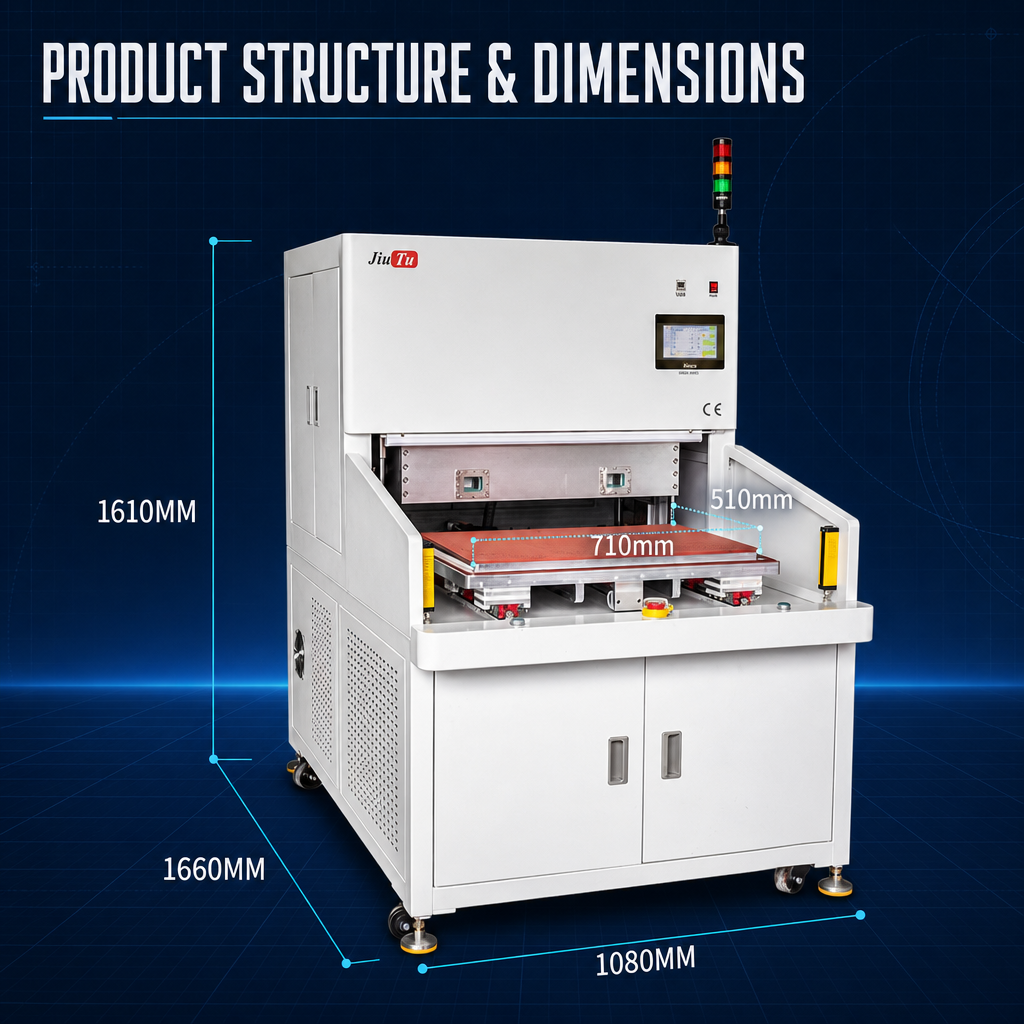
9TU-M040D Industrial Vacuum Laminating Machine
With a 710 × 510 mm working platform and an 85 mm published lamination height, the JiuTu 9TU-M040D gives engineers a basis for assessing the space available for the panel and its tooling. A larger panel might fit the platform on paper, for instance, but its carrier and fixture also occupy part of that space.
The machine offers three programmable stages with independently configurable pressure, processing time and vacuum state. This allows a compatible lamination process to use different loading, dwell and release conditions within the same recipe. Its upper and lower plates can also be heated independently from ambient temperature to 150°C.
These are useful capabilities when assessing the assembly stage of an OCR project. They do not, however, demonstrate that the machine can dispense or cure the selected resin. A factory considering reuse would still benefit from a trial with the intended adhesive and tooling before committing to the surrounding equipment.
If that trial confirms the assembly stage is suitable, the investment may be directed towards the missing resin-processing operations instead of replacing an entire line. If the existing tooling cannot control the gap, modifying the assembly station may be a better starting point than adding a new dispenser.
Comparing the Real Cost of an OCR and an OCA Line
Imagine two suppliers quoting an OCR project. One includes the assembly station and leaves resin application and curing to the factory. The other includes these stages as part of a larger system. Even if both machines accommodate the same panel dimensions, the prices represent different amounts of production capability.
A useful comparison looks at the full route to an accepted display, including tooling, material handling and the time the workpiece spends at each station. Where curing is the slowest operation, for example, adding a faster laminator may not increase overall output. For an OCA line, the equivalent question may concern the capacity of the downstream bubble-removal stage.
The information behind a comparable quotation
- A defined material: The adhesive manufacturer, product code and relevant technical documentation.
- A real display stack: Layer sequence, panel dimensions, bonding area and any openings or protected regions.
- A clear application method: How the material is applied and what conditions must be maintained before assembly.
- A confirmed curing requirement: The curing or post-treatment method and operating conditions, where required by the selected adhesive.
- A production objective: Expected output, fixture needs, available utilities and the acceptance criteria for representative samples.
The sample results then give both sides a common reference for judging the proposed scope. A quotation that specifies how an acceptable display will be produced is more useful than one that simply lists the machines available.
For a broader purchasing review, our guide on how to compare optical bonding equipment quotations covers tooling, included and excluded items, and sample acceptance.
Frequently Asked Questions
Can an existing OCA laminator be reused in an OCR bonding line?
Potentially. Reuse is most plausible when the laminator offers suitable working area, fixture support, gap control and process settings for the selected resin and display. Other resin-processing operations may still require separate equipment.
Does an OCR bonding machine always include dispensing and curing?
No. Some systems integrate several operations, while others cover a single production stage. A quotation for an OCR bonding machine may therefore exclude preparation, dispensing, curing or handling equipment.
What should a resin supplier provide?
The supplier should provide the full material designation, technical data sheet, handling instructions, recommended application method, curing requirements and substrate compatibility information. Mixing, degassing or post-curing instructions should also be provided where applicable.
For a factory moving from film to liquid adhesive, the best outcome may be a combination of existing assembly equipment and new resin-processing stations. For another, a different assembly configuration may make more sense. The display design and material determine which route is worth pursuing.
Application & Equipment Review
Review the Complete Bonding Process Before Selecting Equipment
Planning a new display bonding line or adapting an existing one? JiuTu can review your panel dimensions, display stack, adhesive specification and production goals when discussing suitable lamination equipment. For liquid resin projects, include the resin supplier’s application and curing instructions.
This provides a basis for discussing the assembly equipment and identifying any additional process functions that call for further evaluation.