
Managing lamination recipes across different display assemblies starts with one important rule: a recipe must belong to a validated material stack and process configuration, not simply a product name or screen size. Give each approved configuration a unique recipe ID, keep its material and assembly references together, and control changes through documented revisions.
This matters when one production line handles several display models. Two assemblies may look almost identical but use different adhesive specifications, cover materials or layer structures. Reusing the same machine settings without checking those differences can make a previously validated process unsuitable for the new job.
Assign a Recipe ID to Each Approved Process Configuration
A common mistake in mixed-model lamination is treating the product number as the recipe identity. A product code tells the production team which assembly to make, but it does not necessarily describe the material combination or process conditions required to make it.
Consider two display assemblies with similar external dimensions. One may use a different adhesive grade, while the other may have a different layer sequence or fixture arrangement. Although both products fit the same working platform, their bonding requirements may not be equivalent.
The more useful question is whether the two assemblies share the same validated process conditions. That assessment should consider the material specifications, stack construction, workpiece geometry, tooling and relevant machine settings together.
If these conditions are equivalent, different product numbers may reference the same approved recipe. If a meaningful difference affects the process window, the new assembly needs an engineering review before the existing recipe can be reused.
Keep the recipe ID separate from its revision
A recipe ID identifies the approved process configuration. Its revision identifies the current approved version of that configuration. These two references should remain separate from the product number and drawing revision.
This distinction becomes useful when a display assembly changes but its validated process remains applicable, or when the product number stays the same while the adhesive or material stack changes. In either case, engineering can assess the impact without automatically creating unnecessary recipe records.
The same identification logic also helps production teams when several display families share one machine. Instead of relying on a familiar product name or an operator’s memory, the work order can point directly to the approved recipe ID and revision.
When evaluating equipment for mixed-model production, check whether the working area, tooling compatibility and available process controls match the validated setup. JiuTu’s bonding machine range provides a starting point for comparing relevant laminating options.
Which Fields Must Stay With the Recipe?
The most important distinction is between the recipe master and the production record. The recipe master describes the process that has been approved. The production record shows which materials and recipe revision were actually used for a particular job.
Combining these two records often creates unnecessary complexity. For example, a new adhesive batch does not automatically require a completely new recipe if it meets the existing approved specification. Its lot number belongs in the production record so that the batch can still be traced later.
| Record | Information to retain | Purpose |
|---|---|---|
| Recipe master | Recipe ID, revision and approval status | Identifies the released process |
| Assembly reference | Product number, drawing revision and stack structure | Defines the application scope |
| Process definition | Relevant pressure, temperature, vacuum, timing and stage conditions | Describes the validated settings |
| Production record | Work order, material lot, machine, operator and date | Connects the recipe to an actual run |
| Validation record | Sample reference, inspection result and approval | Supports the release decision |
Material information deserves particular attention. A recipe should identify the approved adhesive grade and relevant supplier specifications, rather than relying on a general description such as optical adhesive or bonding film.
The production record should then identify the actual material lot. If a supplier changes the material specification, or a new grade introduces different process requirements, engineering should review whether the existing recipe remains valid.
Machine settings also need context. A pressure value or heating condition cannot be treated as a universal setting without knowing the material stack, workpiece and equipment configuration to which it applies.
This is especially relevant when a process contains several stages. The sequence and the conditions used in each stage may matter just as much as the final displayed values.
A useful distinction: The recipe master answers, “What process has been approved?” The production record answers, “Which approved process and material batch were used for this job?” Both are necessary for meaningful process traceability.
For a related example of process-window validation, see our guide to validated bubble removal settings. Bubble removal is a distinct process step that may follow lamination, so its pressure, temperature and cycle settings should not be treated as the lamination recipe. The same documentation principle applies: approved settings must remain tied to the relevant material stack, equipment and process stage.
How Are Changes Reviewed and Released?
Not every change deserves a new recipe, but every meaningful process change deserves a review. The decision depends on whether the change affects the assumptions behind the original validation.
A corrected drawing reference or updated document name may be administrative. A different adhesive specification, layer structure, fixture or relevant machine condition is more significant because it may change how the assembly behaves during lamination.
Engineering should compare the proposed configuration with the existing approved one before deciding whether the recipe can remain unchanged, needs a revision or requires a separate process definition.
When the change may affect bonding performance, representative samples should be used to evaluate the revised conditions. The comparison should use the actual material stack and a production-relevant fixture arrangement. Otherwise, an acceptable result may reflect differences in the test setup rather than the proposed recipe change.
For a meaningful comparison, keep unrelated conditions consistent and identify what has changed. If pressure, temperature, loading and adhesive are all changed together, the result becomes difficult to interpret. Engineering needs to know which change produced the observed difference before approving a revised process.
The release decision should also establish the conditions under which the new revision is valid. A successful sample from one material combination should not automatically authorize the same settings for every product in the family.
Keep trials and production revisions separate
A trial setting is not yet an approved production recipe. It should remain identifiable as a development or evaluation condition until the required review and validation are complete.
Once approved, the new revision should have a recorded change reason, validation reference, approval status and effective release. The previous revision should no longer be available for routine production selection unless an authorized procedure specifically permits its use.
Process engineering normally evaluates the technical change, quality reviews the relevant acceptance requirements, and production management ensures that the released version is communicated to operators. The exact approval responsibilities should follow the manufacturer’s own quality and document-control procedures.
This approach prevents an adjustment made during troubleshooting from becoming an unofficial production standard simply because it appeared to improve one sample.
How Can Operators Check the Right Setup Before Starting?
The point where recipe management often succeeds or fails is the changeover. When one display model finishes and another begins, the machine may still be running normally, but the previous recipe can remain selected. The operator needs to confirm that the selected process belongs to the new job rather than assuming that the machine is ready because it has no alarm.
A reliable setup check compares the work order with the approved recipe and the materials physically prepared for production.
- Assembly: Does the product number and drawing revision match the production job?
- Materials: Are the adhesive specification, stack sequence and material lot consistent with the approved requirements?
- Recipe: Does the selected recipe ID and revision match the intended assembly?
- Equipment setup: Are the required tooling, support arrangement and process conditions in place?
These checks should take place before the first production cycle, not after an incorrect setup has already produced workpieces.
Where the machine supports recipe permissions, authorized personnel can be assigned responsibility for changing process settings. If the equipment does not provide revision history or access control, a controlled external recipe register and setup sheet can perform that administrative role.
The important point is that machine recipe storage and complete recipe governance are not the same thing. A machine may recall saved settings, but the production system still needs to establish which revision is approved, which assembly it applies to and who authorized its release.
The 9TU-M040D Industrial Vacuum Laminating Machine is particularly relevant to this requirement. Its published configuration includes Siemens PLC control with storage for up to 14 recipes. Each recipe can contain three automatic stages, with pressure, processing time and vacuum state configured independently for each stage. If production requires more than 14 active recipes, confirm how additional configurations will be stored, identified and released before selecting the machine.
Relevant equipment configuration
9TU-M040D Industrial Vacuum Laminating Machine
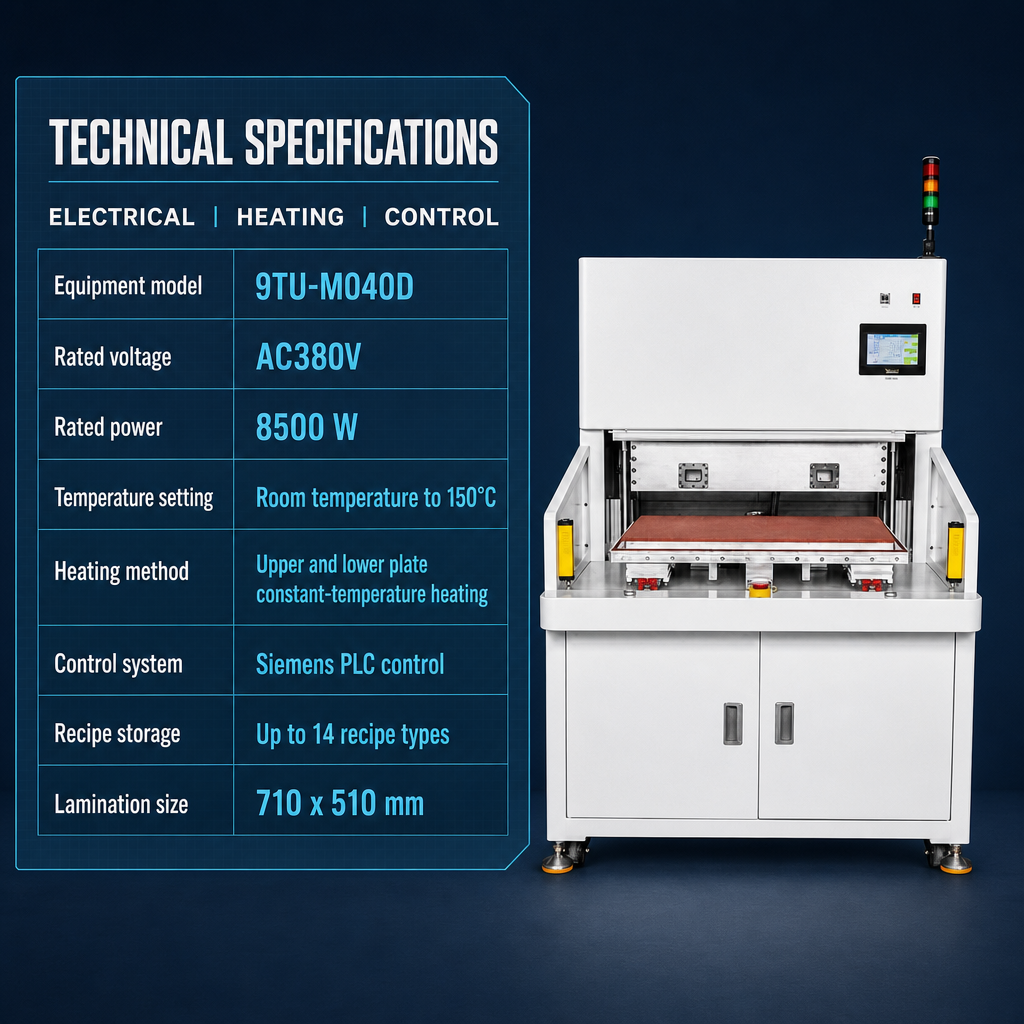
This configuration is worth evaluating when production involves several validated lamination settings that operators need to recall for different workpieces or process stages.
Its stored recipes can support process selection, but the published specification does not establish automatic recipe revision approval, user-level access permissions or a complete audit trail. Those requirements should be discussed separately when defining the production workflow.
There is also a different equipment consideration when the main process requirement concerns pressing force or final displacement rather than stored recipe recall. The 400×400-2T Servo Laminating Machine documents pressure and displacement modes, adjustable motion and independent heating. Its published specifications do not confirm recipe storage capacity, so it should be evaluated as a servo pressing configuration rather than assumed to provide the same recipe-management workflow.
For either configuration, the final equipment decision should follow the actual display stack, required process conditions and production recordkeeping requirements.
What Should Happen After a Failed or Interrupted Run?
A failed cycle or unexpected production stop should not automatically lead to another run using the same settings. First, establish what happened to the affected workpieces and whether the intended process sequence was completed.
For example, a machine interruption may leave uncertainty about the last completed stage. The selected recipe could still be correct, but that does not prove that the workpiece received the complete process. Restarting without reviewing the process history may introduce another uncontrolled condition.
The affected work order should remain identifiable, and uncertain workpieces should be held for assessment under the site’s quality procedure. The production record should retain the recipe ID and revision, material lot, machine, operator, interruption details and last confirmed process stage, together with any available machine records.
Engineering or the designated quality authority can then decide whether additional inspection is sufficient, whether the process can continue under an approved procedure, or whether the affected work must be rejected.
Just as importantly, a failed run should not silently change the master recipe. If an operator makes a temporary adjustment during investigation, record it as a deviation or trial. Only a reviewed and validated change should become a new production revision.
When a problem appears repeatedly, compare runs using the same assembly, material specification, fixture and recipe revision. This helps distinguish a genuine process change from a material-batch issue, setup inconsistency or isolated interruption.
Good process traceability is not about collecting as many machine values as possible. It is about being able to reconstruct what was manufactured, which approved conditions were used and what changed when the result was different.
Frequently Asked Questions
Should similar stacks share a recipe?
They can share a recipe when their material specifications, stack construction, tooling and validated process requirements are equivalent. Similar dimensions or product names alone are not enough to establish process equivalence.
What if a machine cannot export recipe data?
Use a controlled external recipe register and setup sheet to record the approved ID, revision, settings and applicable assembly. Link each production run to the selected recipe and actual material batch. Manual records should be identified as external records, not automatic machine traceability.
Who should authorize a recipe change?
Process engineering should normally review the technical change and recommend release. Quality should review the relevant acceptance requirements, while production management ensures that only approved revisions are used. Follow the site’s established approval procedure.
Lamination Process & Equipment Review
Make Recipe Selection Part of Your Production Control
Managing lamination recipes across different display assemblies is ultimately about maintaining a clear relationship between the product, material stack, approved process and production history.
For an equipment configuration review, provide the actual display assembly drawing, material specifications, fixture details and the process conditions that need to be stored or recalled. It is also useful to explain how many different assemblies share the production line and how recipe changes are currently approved.
- Display assembly and drawing revision
- Material stack and adhesive specification
- Workpiece and fixture dimensions
- Required pressing and heating conditions
- Number of validated process configurations
- Production changeover requirements
- Recipe storage and revision-control expectations
- Sample validation requirements
These details help establish whether the proposed machine configuration can support the required process settings and where external recipe records or approval controls may still be needed.