
A film laminating machine may need a local fan filter unit (FFU) when clean adhesive or substrate surfaces are exposed to airborne particles before bonding. The case is strongest when contamination develops during loading or positioning rather than arriving with the material. An FFU can reduce airborne exposure around that part of the process, but it will not solve particles transferred by gloves, fixtures or incoming film.
The Defect Appears After Bonding. The Cause May Be Earlier.
When a particle shows up under an optical film, it is easy to blame the bonding step. By then, however, the film and substrate have already passed through several moments when contamination could have entered. The finished panel shows the consequence, not necessarily the source.
Take a common loading sequence. The adhesive arrives protected by a release liner, and the glass is cleaned before the film is applied. Once the liner comes off, the adhesive is exposed while the operator prepares the two surfaces for contact. If the glass is waiting uncovered on the table at the same time, there are now two surfaces on which airborne particles may settle.
Yet the same defect can come from a different route. A particle may already be present on the incoming film, or it may transfer from a glove, fixture or vacuum platform. An overhead FFU would not correct those sources. That is why the sequence before bonding matters more than the appearance of the final mark.
A quick look at the surfaces at different moments can change the direction of the investigation. If the adhesive is clean as the liner comes away but becomes contaminated during positioning, the surrounding air becomes a plausible contributor. If the contamination is visible immediately, attention belongs further upstream.
This distinction should shape how buyers compare film laminating machines. The relevant difference is not simply whether FFU appears on the specification sheet; it is how the machine handles the material during the time it is most exposed.
When Filtered Air Has a Job to Do
A local FFU makes sense when the vulnerable part of the process happens in a predictable place. With OCA, polarizer films and other optical materials, the adhesive or freshly cleaned substrate can remain uncovered while the operator aligns the surfaces. That creates an interval in which airborne particles may reach the future bonding interface.
Supplying filtered air over that interval can be more relevant than trying to improve the appearance of the whole workshop. A room may look tidy while particles still settle on an exposed work surface. Conversely, dust visible elsewhere in the building does not prove that the defects on a particular laminator came from the air.
There is a useful contrast: when a surface is clean immediately after preparation but picks up particles while it sits uncovered, the air around the station deserves attention. When the particles are already present before loading, they are more likely to require a material, cleaning or handling correction. The finished defect may look much the same, but the next equipment decision is different.
For a worktable-based process, an overhead FFU offers one way to direct filtered air toward the exposed area. Its effectiveness depends on whether the material remains within that area during normal loading—not merely whether the machine is fitted with a filter unit.
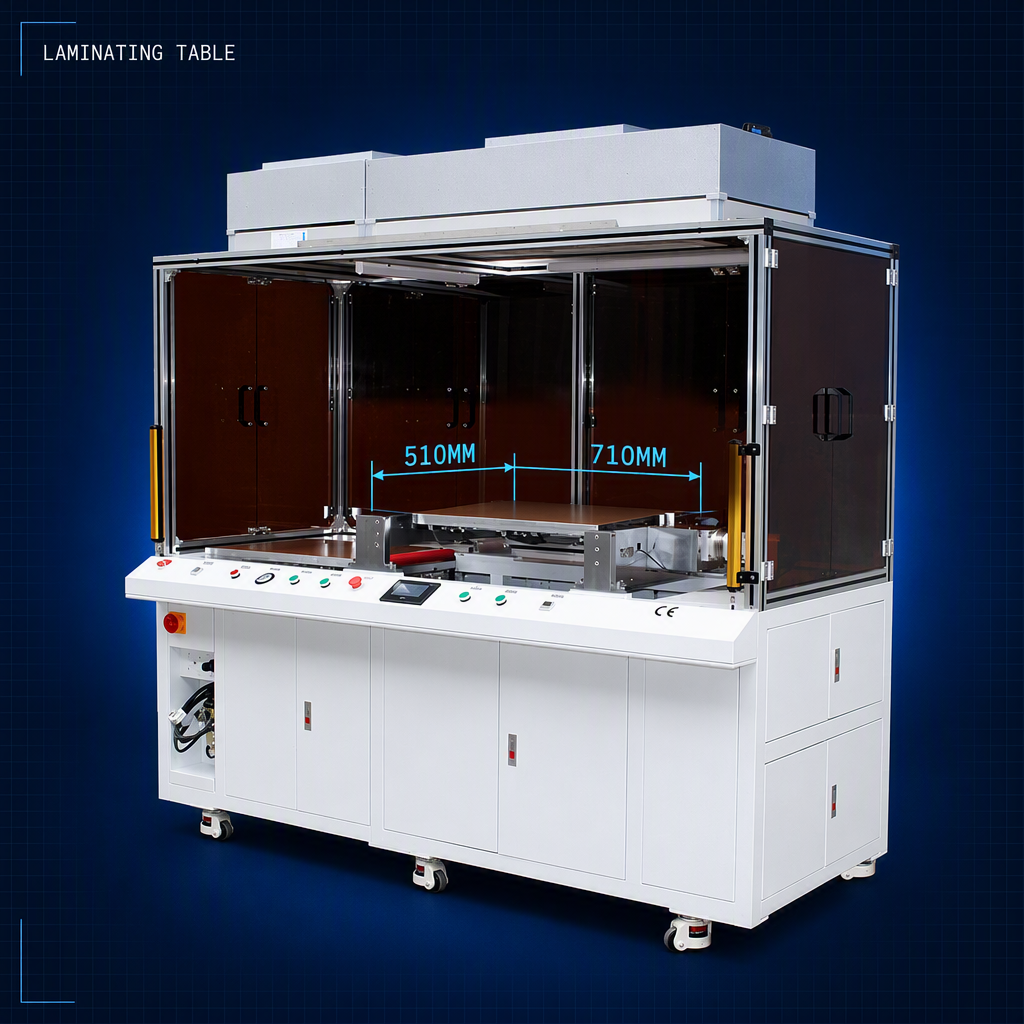
Local FFU Workstation
510×710 Film Laminating Machine with FFU
In the 510×710 model, the film and rigid substrate sit on separate platforms beneath an overhead FFU. That layout is useful to examine when loading and bonding happen in one accessible work area. It also makes the limitation easy to see: the exposed adhesive only benefits while it remains in the path of the filtered air.
The Workstation Is Different Once Production Starts
Watch an operator peel off a release liner and bring a sheet toward the substrate. The operator leans into the work area, hands pass over the glass and the film briefly occupies space that was empty a moment earlier. Air flowing evenly over an unused table may behave differently during those few seconds.
That matters most at open loading stations. A sleeve, tool or large workpiece can interrupt the path of filtered air, while packaging and discarded liners nearby create additional opportunities for particles to enter the process. The practical arrangement of the workstation can matter as much as the unit mounted above it.
Cleaner air must not make a flexible film harder to place
A glass substrate stays rigid, but a thin film can curl, lift or flutter when it is not fully supported. How strongly it responds depends on its stiffness, size, the support method and the airflow direction. An arrangement that keeps dust away but makes the film difficult to position has traded one problem for another.
This is particularly relevant when the operator has to remove a liner while holding a sheet in position. Film support, rather than the nominal filter specification alone, determines whether the handling remains predictable.
The film may move through the airflow, too
Machine structure changes that picture. A stationary platform keeps the material in one general working area; an upper flip mechanism moves the film along a different path before contact. Both arrangements can use filtered air, but the vulnerable surface does not occupy the same position throughout the cycle.
The 700×1200 industrial FFU flip-type model illustrates that difference. Its upper structure carries the film toward the substrate on the lower table. The question is how the film remains supported and protected while it moves, not simply whether an FFU is visible above the equipment.

Flip-Type Film Handling
700×1200 Industrial FFU Flip-Type Film Laminating Machine
The 700×1200 flip-type arrangement holds the film on an upper structure that rotates toward the substrate below. This changes the film’s path through the work area and places more emphasis on what happens to the exposed surface during movement, not just at the final bonding position.
Neither layout removes the need for accurate positioning. A clean film can still be misaligned, which is why alignment methods for optical film application belong to a separate part of the equipment decision.
A Clean-Air Zone Is Only Part of the Process
Not every blemish under a bonded film begins as an airborne particle. Residue on a substrate, dust carried in with incoming material or debris transferred by a vacuum platform can produce defects that look similar after lamination. Filtering the surrounding air cannot remove a particle that is already on the surface.
Static charge can make the problem less straightforward. A charged film or substrate may attract particles during handling, so its behaviour depends on more than filtration alone. That is a reason to consider static-control practices and the path the material takes into the workstation, rather than assuming a stronger FFU will settle the issue.
There is also a difference between making air cleaner over a worktable and claiming a cleanroom classification. A local FFU does not establish the cleanliness of the storage area, neighbouring stations or the room as a whole. Any quoted cleanliness level needs a defined measurement point, method and operating condition.
For that reason, the filter grade on a product sheet is only part of the story. The useful supplier information includes the filtration specification, the intended airflow coverage at the working surface and how that coverage is assessed with the machine in use. Maintenance matters as well: filter loading, leakage or bypass can change performance after installation.
Let the Defect Pattern Decide
It is tempting to compare the stated filter grades of two machines and stop there. But the reason to add an FFU is to reduce particles at the bonding interface, so the more convincing evidence comes from the process itself.
Imagine an operator handling the same type of optical film on two otherwise comparable runs. In one, the existing workstation is used as it is. In the other, local filtered air covers the exposed surface. The film batch, cleaning method, liner-removal timing and inspection method stay as consistent as possible. This is a proposed comparison, not a claim about measured results.
Looking only at the finished panel can conceal where the contamination entered. A surface check immediately after liner removal may reveal an issue that would otherwise be blamed on the laminator; a particle appearing later, while the sheet is uncovered, points to a different exposure. Substrate inspection provides another clue.
Particle measurements can add context, but a number recorded near a filter outlet does not describe conditions at the adhesive during loading. Sampling location, instrument method and whether the operator and workpiece were in place all affect how the data should be interpreted.
There is no universal defect threshold for every film and adhesive combination. The acceptable result depends on the display application and must include both particle-related defects and film stability. A cleaner surface is not an improvement if a flexible sheet becomes harder to place accurately.
If the filtered-air run shows a repeatable reduction in defects under comparable conditions, there is a reason to consider FFU as part of the machine configuration. If little changes, attention is better directed to incoming materials, contact surfaces and the handling sequence. Either result is useful: it keeps the equipment decision tied to the problem rather than to a feature list.
For a view of where this station fits in the wider assembly line, see our guide to equipment for film lamination, OCA bonding and bubble removal.
Frequently Asked Questions
Does FFU certify the whole room as clean?
No. It supplies filtered air to a defined working area, not the entire room. A room cleanliness classification requires its own measurements under specified operating conditions.
Can airflow disturb a loose film?
It can, particularly when a thin sheet is partly unsupported. Film stiffness, support and the direction of airflow matter; a practical trial should include liner removal and transfer, not just the film resting on the platform.
How can contamination sources be separated during trials?
The timing helps. A particle present before the liner comes off suggests a different source from one that appears only while adhesive is uncovered. Looking at the film and substrate before contact, then at the bonded interface, makes the pattern easier to interpret.
Application & Configuration Review
Choose the Machine Around the Exposure Point
An FFU is worth considering when the vulnerable part of your process is a clean surface waiting to be bonded. If contamination is already present on the incoming material, or arrives through a tool or fixture, changing the air above the machine may leave the defect unchanged.
OLED Machine offers both dual-platform and flip-type film laminating arrangements. The more useful discussion is not simply which one has an FFU, but where your film becomes exposed, how it moves before contact and whether the airflow can protect it without affecting handling.
Share the film and substrate sizes, adhesive type, loading sequence, expected output and any defect photographs when requesting a review. Those details give the team a basis for discussing the appropriate work area and machine layout rather than choosing filtration on its own.