
LCD/OCA Autoclave Sizing Guide
Choose autoclave chamber size for LCD screens from the complete loaded assembly, not from the screen diagonal or a nominal chamber number. Start with the largest panel in the orientation it will actually be processed, add the rack, fixture or tray, and allow the handling clearance required to load it safely. Then check whether that layout supports the intended pieces per batch and daily throughput. Only after the load is defined should the door opening, chamber geometry, workshop route, utilities and machine footprint be compared.
Nominal Chamber Size, Door Opening and Usable Loading Space Are Different
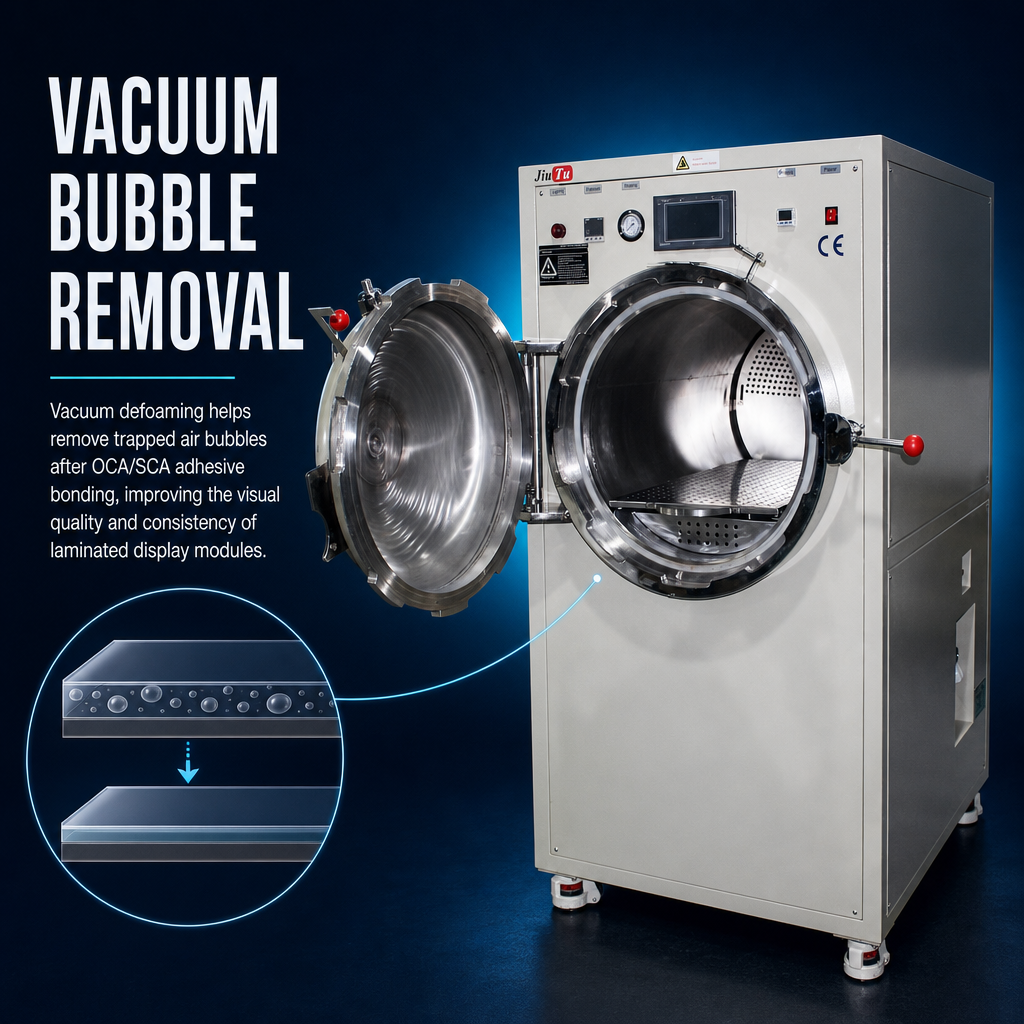
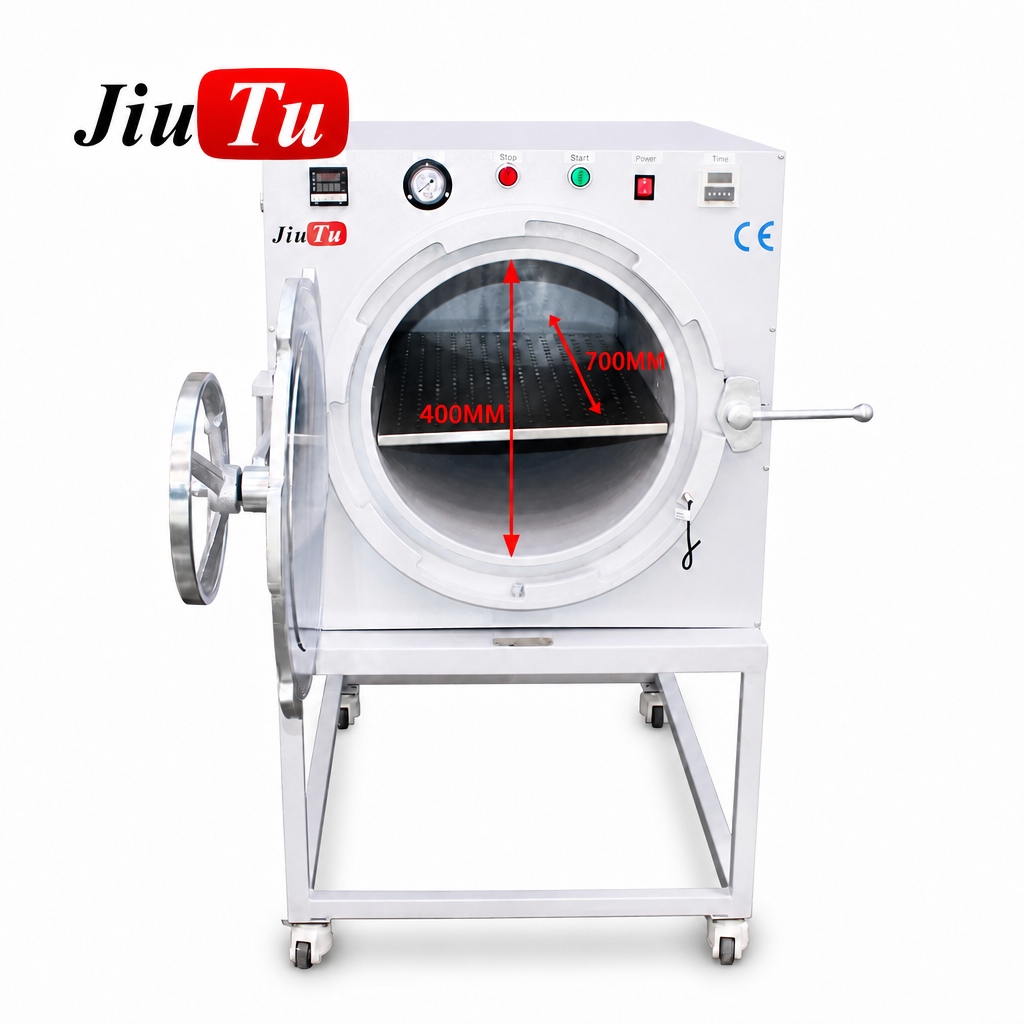
A chamber specification is only the starting point. An LCD/OCA bubble removal autoclave may have a cylindrical internal chamber, shelving, rack supports and a front door whose opening is different from the maximum internal diameter. Those dimensions answer different questions.
The nominal chamber tells you the basic vessel geometry. The clear door opening determines whether the loaded assembly can physically enter. The usable loading envelope is the space that remains after shelves, fixtures and the required handling clearance are taken into account.
Width, height, thickness, frame, FPC, connectors and other projections.
The complete assembly in the exact orientation used during loading.
The loaded envelope must pass through the entrance and fit the intended shelf position.
This distinction becomes more important as panel size increases. A rectangular fixture placed inside a round chamber does not use the full circular cross-section, and a component that fits geometrically inside the vessel may still be difficult to maneuver through the door.
Practical rule: ask for the nominal chamber dimensions, clear door opening and usable loading dimensions with the proposed rack installed. Do not treat those three values as interchangeable.
Once the required loading envelope has been established, compare an autoclave machine by chamber geometry, loading arrangement and fit for the intended LCD/OCA workflow rather than by one size number alone.
Build a Real Loading Sketch Before Choosing LCD Autoclave Size
The largest screen dimension is not enough to answer what autoclave size fits large LCD panels. The useful measurement is the complete object that will enter the chamber.
For each important panel family, record the following dimensions before comparing equipment.
- Panel envelope
- Overall width, height and thickness rather than diagonal screen size.
- Protrusions
- Frames, FPC tails, connectors, brackets or other parts extending beyond the main panel.
- Fixture or tray
- Outside width, height and depth of the support used during the bubble-removal cycle.
- Orientation
- The actual direction in which the assembly is inserted and positioned on the shelf.
- Handling space
- Clearance required to insert, position and remove the load without forcing it against surrounding parts.
Avoid adding an arbitrary percentage for clearance. There is no universal clearance value that applies to every LCD/OLED module, fixture and chamber. When the fit is close, the machine supplier should confirm the proposed layout against the actual chamber and door geometry.
Turn the Loading Layout into Batch Capacity and Daily Output
After confirming that the largest assembly fits, the next question is not simply “How large is the chamber?” It is “How many real products can this layout process within the required production window?”
This is where panel loading capacity becomes more useful than chamber volume. Start by drawing a normal production batch. If the operation handles mixed panel sizes, do not calculate capacity only with the smallest product or with an ideal arrangement that rarely occurs in practice.
Two calculations should agree before the chamber size is approved
Actual occupancy time should reflect more than the programmed process period. Loading, unloading and any regular changeover also consume production time. The pressure, temperature and cycle settings themselves should come from the validated process for the actual material and panel structure, not from an unrelated machine or another adhesive system.
This is the practical relationship between autoclave chamber size and daily output: a larger chamber adds value only when its usable layout increases useful batch capacity or supports a required panel size. Empty internal volume does not create throughput by itself.
For mixed production, compare LCD bubble removal autoclaves against at least two layouts: the largest regular assembly and a typical mixed batch. That reveals whether the chamber works only for an exceptional product or also fits the everyday workload.
Check the Loading Route, Floor Space, Utilities and Maintenance Access
An autoclave machine for LCD production can fit the panels and still be wrong for the facility. Before ordering, trace the complete route from delivery to the final operating position.
- 01 Delivery access Entrance, loading area and any unavoidable restrictions.
- 02 Travel route Doors, corridors, lifts and turning points where applicable.
- 03 Operating space Machine footprint plus room to load panels comfortably.
- 04 Door movement Clear area for the chamber door and the operator.
- 05 Service access Space for maintenance points and required utility connections.
Record the available electrical supply and confirm the required voltage for the proposed configuration. Where a machine requires compressed air or another external utility, verify the connection and supply requirements instead of assuming an existing workshop service is sufficient.
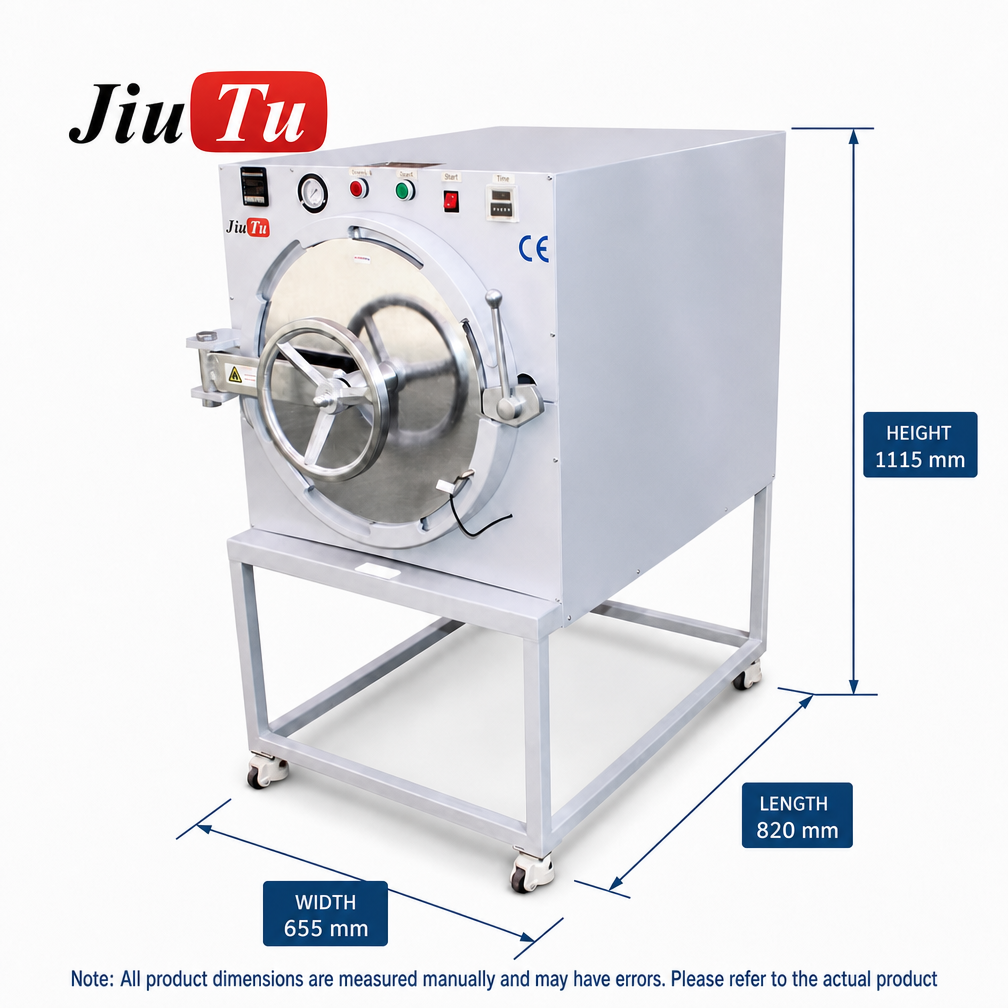
Floor planning should also include the path used by the fixture. A machine can technically fit between other equipment while leaving too little room to maneuver a large loaded tray in front of the chamber.
What Changes When the Chamber Is Too Small, Too Large or Used for Mixed Sizes?
Undersized
The load dictates the workaround
If the largest panel fits only after removing the intended fixture, changing orientation or reducing the normal batch, the original sizing basis is incomplete. The chamber should be checked against the production load, not the bare display.
Oversized
Extra volume needs a reason
A larger chamber can support future panel sizes or larger batches, but only if the usable rack layout turns that space into practical capacity. It may also require more floor and access space.
Mixed sizes
Layout matters more than theory
A chamber that looks efficient with one panel family can leave unusable gaps in a mixed batch. Draw the combinations that actually appear in production rather than relying on a theoretical maximum piece count.
Compact chambers can make sense for operations dominated by smaller displays, while larger formats become relevant when panel dimensions, fixtures or batch requirements genuinely demand additional usable space. The decision should come from the loading plan rather than the assumption that more chamber volume is automatically better.

What Information Should Be Sent Before Requesting an Autoclave Configuration?
A useful quotation request should give the equipment supplier enough information to reproduce the intended loading logic before recommending chamber dimensions.
- Maximum panel dimensions including thickness and projections
- Regular size range when multiple LCD/OLED products are processed
- Fixture or tray dimensions with a drawing or clear photograph where possible
- Loading orientation and intended pieces per batch
- Material information for the OCA or applicable bonding process
- Expected daily output and representative batch mix
- Current defect or process requirement for the bubble-removal stage
- Voltage and utilities available at the installation point
- Destination and known doorway or workshop access limits
- Sample or application photos when the geometry is unusual or difficult to describe
A real loading drawing is more valuable than a request such as “I need a machine for a 65-inch screen.” Diagonal size does not show the complete module envelope, fixture dimensions, batch arrangement or available workshop access.
Before placing an order, confirm the maximum loaded assembly, representative mixed batch and installation route in writing. That gives both the production team and equipment supplier a common basis for checking the proposed bubble remover chamber dimensions.
Frequently Asked Questions
Is the largest panel dimension enough to size an autoclave?
No. It establishes only the basic product envelope. The chamber also has to accommodate the panel thickness, protruding components, fixture or tray, loading orientation and the clearance required to pass through the door and position the load.
How much loading clearance is needed around LCD panels?
There is no universal clearance value for every LCD/OCA application. Use the clearance required by the actual fixture, chamber geometry and loading method. When dimensions are close, request confirmation using a loading drawing rather than applying an arbitrary percentage.
Should chamber size be based on one batch or daily output?
Both matter, but in sequence. First verify that the largest real panel-and-fixture assembly fits. Then determine realistic pieces per batch and check whether the required number of batches can be completed within the available daily production time.
What workshop measurements are needed before ordering?
Check the delivery route, doors and corridors, turning space, final floor area, chamber-door clearance, operator loading area, maintenance access and utility connection points. These measurements should be reviewed separately from the chamber dimensions.
Application & Configuration Review
Choose the Chamber from the Verified Load, Not the Catalog Number
The right autoclave chamber size for LCD screens is the one that fits the complete loaded assembly, supports the required batch mix and can be installed and operated within the real workshop. Exterior machine size or a theoretical number of panels should never substitute for checking usable chamber space.
Prepare a loading sketch with the maximum panel, fixture dimensions, representative mixed batch and access conditions before requesting a final configuration. This makes it possible to compare chamber options against the application rather than selecting equipment from nominal dimensions alone.